
The MAX IV and QMat Summer School combined hands-on training with theory on XPS, XAS, ARPES and RIXS
– Through the Summer School, we get to interact with the students in a more informal way, says Alexander Klyushin, beamline scientist at the SPECIES beamline at MAX IV.
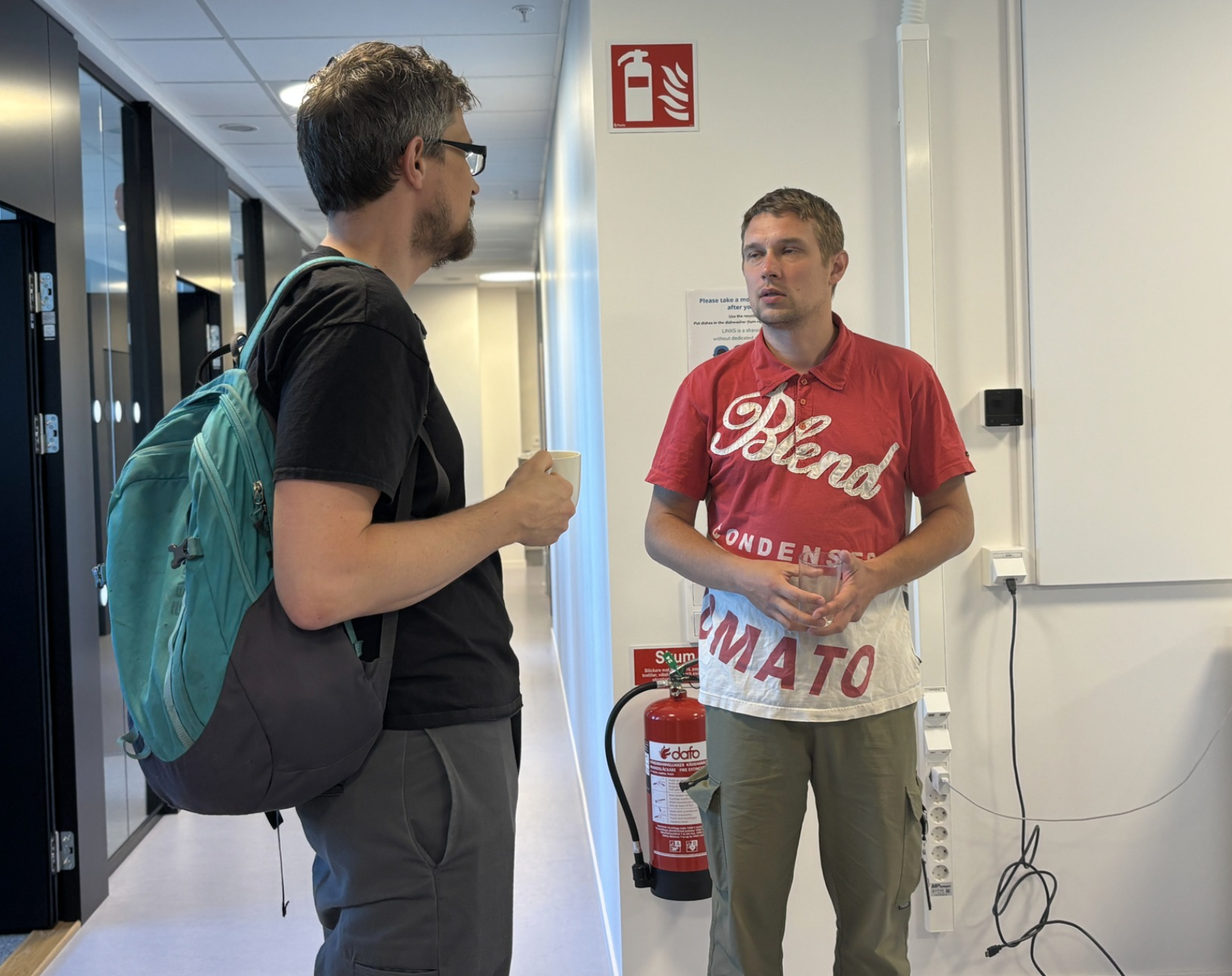
Alexander Klyushin (to the left) is pictured speaking to one of the lecturers at the Summer School at LINXS in August.
Alexander Klyushin recently organised a five-day long summer school together with the LINXS theme QMat: Quantum materials: Linking theory and experiments at LINXS, ESS and MAX IV. The aim was to showcase techniques suitable to quantum materials, offer support in data analysis, and provide opportunities for PhD students to engage with experienced scientists.
– Together with LINXS and QMat we are in a unique position to combine hands on exercises with facility lectures, which is a very strong component of the school. In one week, our students get to learn everything from measurements to data analysis. And they want to learn even more!
Andrew Boothroyd, leader of the QMat theme and Professor of Physics at Oxford University, was pleased with how the school turned out.
– This school provided an excellent introduction for early-career researchers into the new capabilities available at MAX IV and how X-ray techniques can be used to investigate quantum materials. I am delighted that the LINXS QMat theme was able to partner with MAX IV to put on the school. The school will help to realise the QMat theme’s aim to promote the exploitation of the ESS and MAX IV for research in quantum materials. I congratulate Alexander for a successful educational programme, says Andrew Boothroyd.
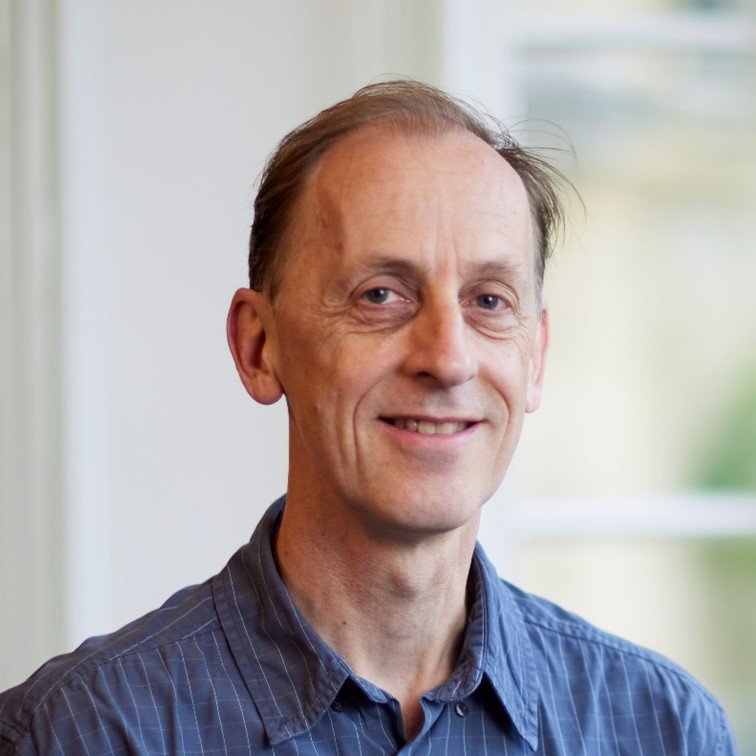
Andrew Boothroyd is delighted with the outcome of the school, that he thought provided a great opportunity to learn about what techniques and beamlines are available at MAX IV for research related to quantum materials.
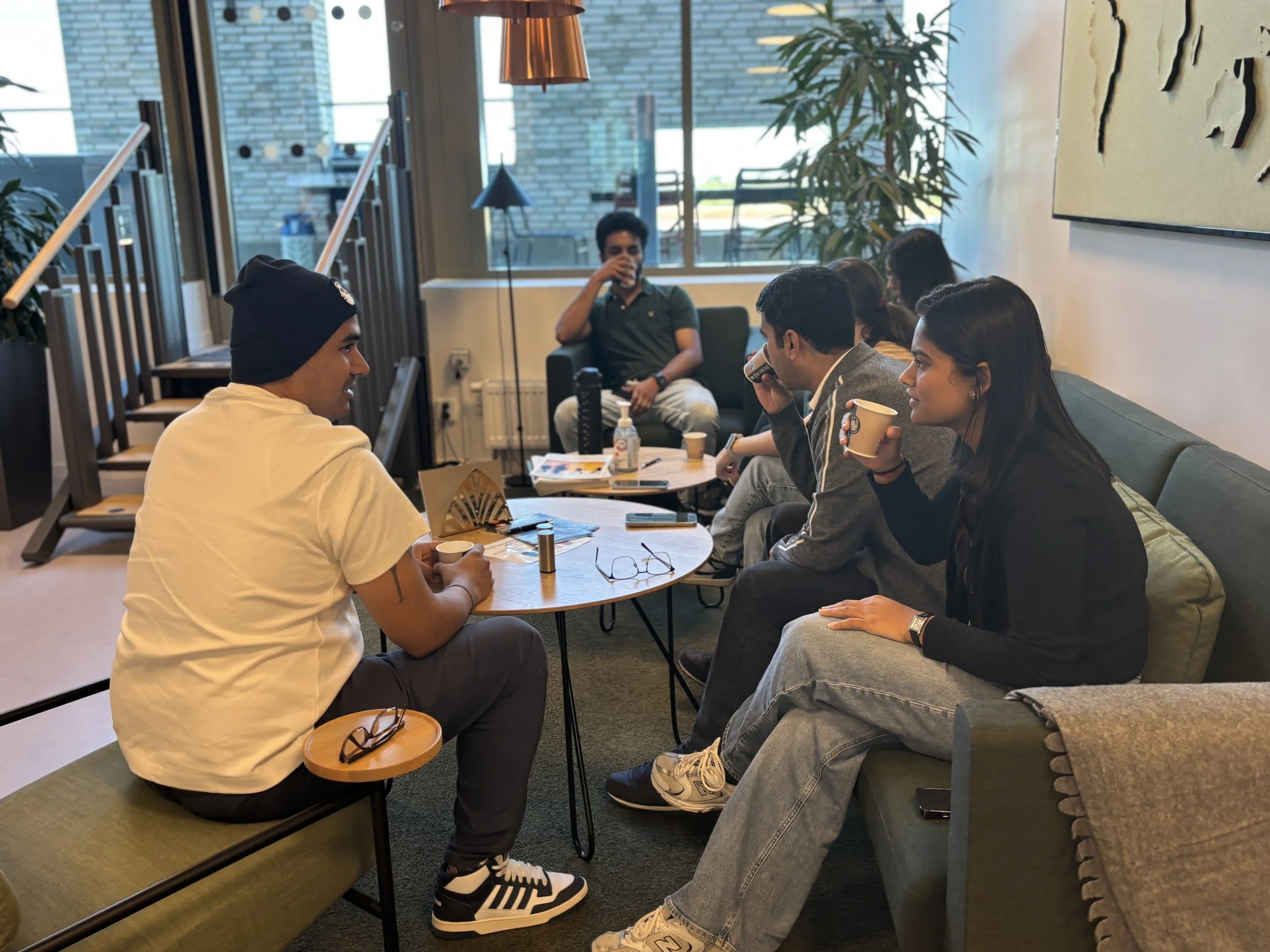
The school gathered interested researchers from different places and backgrounds.
Together with researchers from the QMat theme, Alexander Klyushin chose to focus on four techniques of relevance to the study of quantum materials: X-ray photoelectron spectroscopy (XPS), angle-resolved photoemission spectroscopy (ARPES), X-ray absorption spectroscopy (XAS), and resonant inelastic X-ray scattering (RIXS). While ARPES and RIXS are quite challenging techniques to learn, XAS and XPS are easier for beginners to grasp. The students were also shown different software for data analysis such as CasaXPS for XPS, Python for ARPES and Origin for XAS.
– We are busy at the beamlines, and data analysis remains the big bottle neck. If we can support students to become confident in the general concepts of data analysis, we can make a big difference, says Alexander Klyushin.
Sample requirements and the potential and limitations of beamlines
Alexander Klyushin also reflects that students need more coaching in how to write beamline proposals, as well as knowledge on what samples suit the different beamlines. Thus, they included targeted sessions on beamline proposal writing, as well as organised meetings with dedicated beamline scientists, who represented some of the different beamlines at MAX IV. They explained the limitations of the different beamlines in terms of temperature and length scale range. For experiments which require very low temperatures, which involves freezing for example, one can use the Bloch beamline to perform angle-resolved photoemission spectroscopy (ARPES) experiments. This beamline is suitable for the study of electronic structures of surfaces and of 2D materials. At the SPECIES beamline, where Alexander Klyushin works, one can instead do experiments requiring temperatures of up to 1000 degrees.
– We also explain that you can combine different techniques. It is very seldom you get everything you need from just one type of experiment. It is a more complex system than what you might think.
Focused Summer Schools makes for more targeted content
Alexander Klyushin enjoyed the collaboration with the QMat theme, especially the focus on quantum materials. He says that a specific focus makes for a more targeted school as all the content have a common theme which binds the techniques and exercises together. Meeting students is something he also enjoys a lot, especially as he is very busy in his job as a beamline scientist.
– I like to share my knowledge with the students and to interact with them. In my role at SPECIES, I am usually very focused on helping users to tackle their own scientific questions. I love this aspect of my job, but these schools are an opportunity for more informal discussions.
Since 2020, he has worked at the SPECIES beamline, which focuses on experiements related to catalysis, photocatalysis, materials science and fundamental physics. Before he that worked in Berlin, Germany. He completed both his PhD, which focused on heterogenous catalysis, and his postdoc at the BESSY II synchrotron in Germany.
Currently he is involved in developing a new instrument at MAX IV, for X-ray absorption spectroscopy (XAS). The limit of the existing instrument at MAX IV is in the millibar range. Him and his colleagues aim to improve it so that it can better mimic the industrial conditions that the Swedish industry is interested in testing. Many companies are eager to study how materials behave under ambient pressure, to improve the storage capacities and performance of batteries, or improve catalysis for example. With the improved instrument one will also be able to study atmospheric conditions such as cloud formations and carbon dioxide emissions.
– I am interested in solving this technical challenge and to support industries to learn more about materials and products, says Alexander Klyushin.
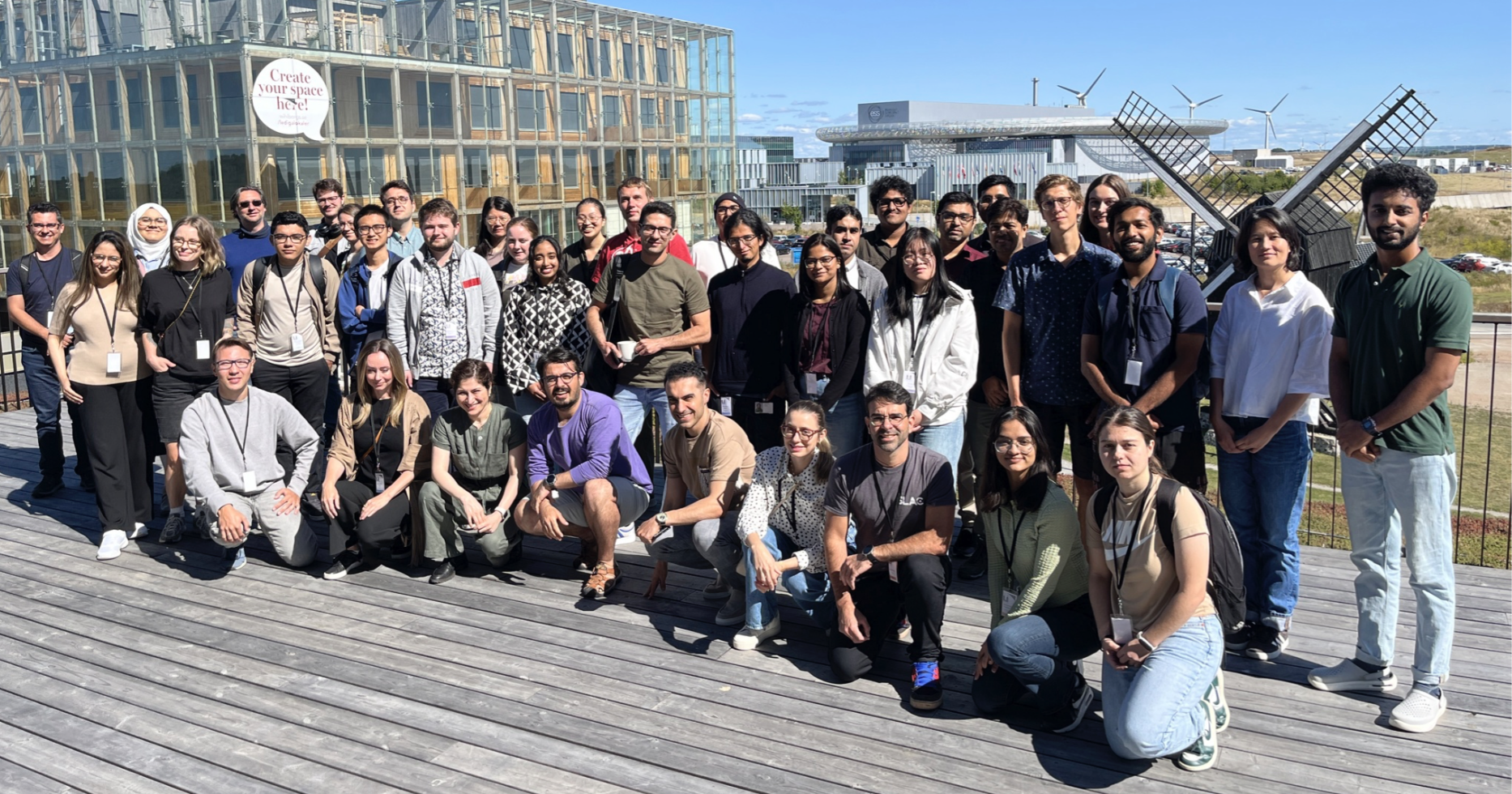
The Summer School had specific focus on techniques suitable to the study of quantum materials: X-ray photoelectron spectroscopy (XPS), angle-resolved photoemission spectroscopy (ARPES), X-ray absorption spectroscopy (XAS), and resonant inelastic X-ray scattering (RIXS).