
The design of sample environments in X-ray imaging takes centre stage at workshop
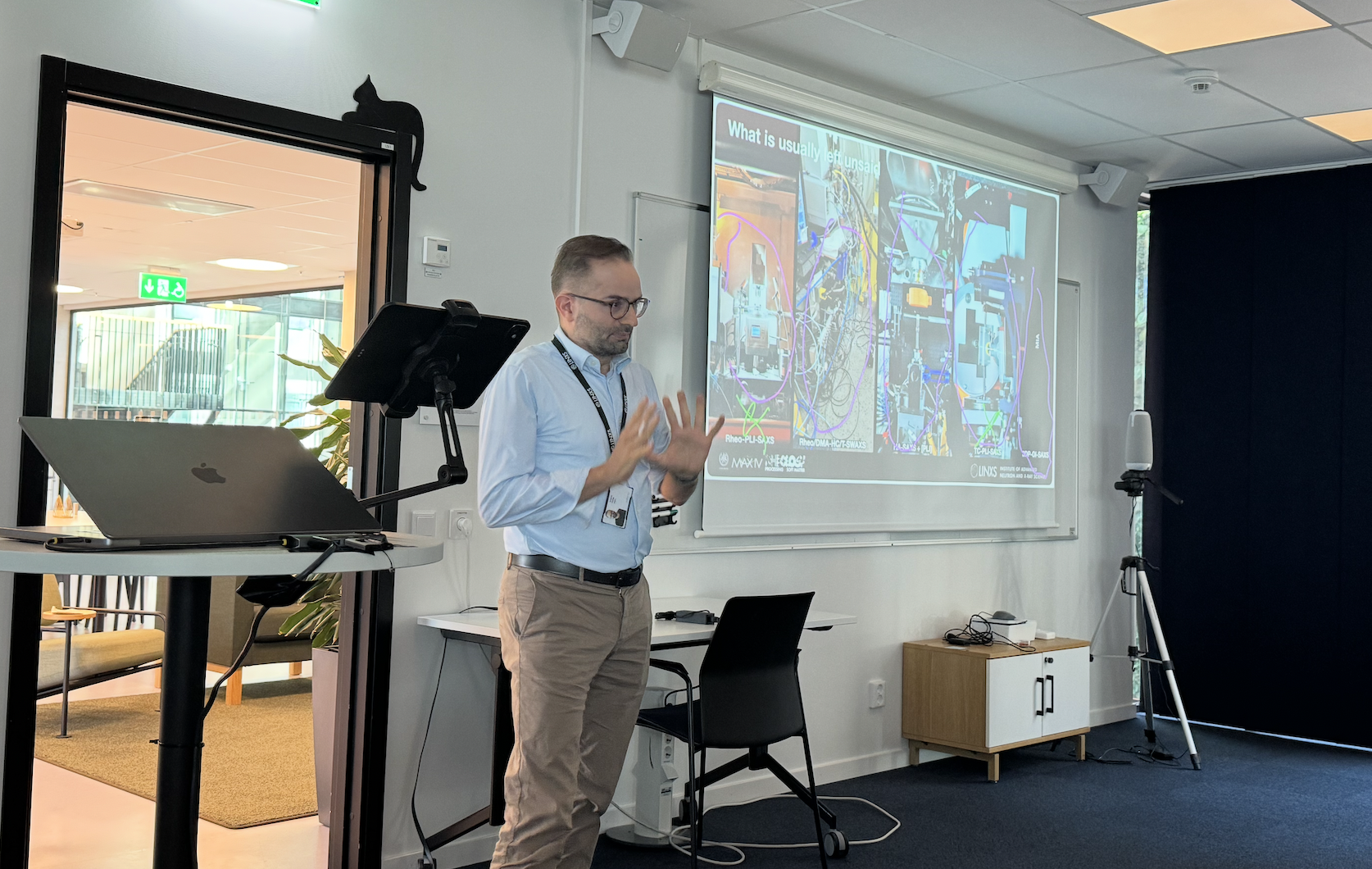
Roland Kádár, who leads the RheoMAXESS theme at LINXS, was one of the speakers at the event. HIs talk was entitled: Rheology and X-ray scattering
A recent workshop with more than 90 participants organised by the AIDA theme in September aimed to highlight the design of sample environments in X-ray imaging, and encourage collaboration between mechanical engineers and beamline scientists.

Emanuel Larsson is LINXS Co-Director and was part of leading the MEDSI parallel workshop.
– Sometimes the engineers who create and design a sample environment never gets to see it in action or even find out if it works well. We wanted to bridge this gap between those who make, and those who use, the environments, says Emanuel Larsson, LINXS Co-Director, who was part of organising the workshop.
It was organised as a side event to the bi-annual International Conference on Mechanical Engineering Design of Synchrotron Radiation Equipment and Instrumentation (MEDSI) which was held at The Loop in Science Village in Lund.
Today, sample environments are often designed and developed, either by user groups at universities, by engineers directly at the synchrotron facility, or by companies.
Invited speakers to the workshop were both engineers who build sample environments and beamline scientists and users who have commissioned them. They were encouraged to highlight how and why they made certain decisions, identify challenges, and share tips and tricks.
Examples included design and material decisions relating to sample environments for bread baking in a microwave oven, the dynamics of freeze drying and 3D printing of plastics, and tips and tricks when procuring commercially available sample environments. They covered considerations such as choice of material to allow enough transparency of the X-rays during experiments.
This technology-science focused workshop was very appreciated reflects Emanuel Larsson. Participants asked detailed questions, including why an environment was modified a certain way, or what energy was used for a given application, plus that the participants took a lot of photos during the presentations.
– It was great to see the engagement and the interest in the technical details. I think the presentations brought home to many of the engineers why certain considerations are important for a successful experiment.
– The whole point with our event was to facilitate thinking and collaboration around these issues: what parameters should you keep in mind when designing sample environments?
Time is key for a successful beamtime experiment
Emanuel Larsson emphasises that prior to beamtime at a synchrotron, one needs to devote sufficient amount of time to both sample preparation and testing of sample environments, including fine tuning, and detecting and addressing potential challenges, since everything has to work smoothly at the synchrotron, in order to make efficient use of the beamtime and obtain both representative and high quality data.
– The main body of work needs to be done before you go to the synchrotron. That is why it is so important that users know how to design sample environments that suit the synchrotron facility, or have knowledge of how they can make use of already existing sample environments.
He hopes that the event will support new networks and grow interest in sample environments. As more researchers start using large-scale facilities this knowledge is important.
– We need to build capacity in all aspects of X-ray imaging, going all the way from writing beamtime applications, to sample preparation, to design and testing of sample environments, to data evaluation. Sample environments and sample preparation are a huge part of this as proposal revision panels often want to see proof of concept before they grant a user beamtime, says Emanuel Larsson.
Read more about the AIDA theme