
LINXS Guest Seminar: "Inelastic neutron scattering reinterpreted" with Nic Shannon - QMat theme
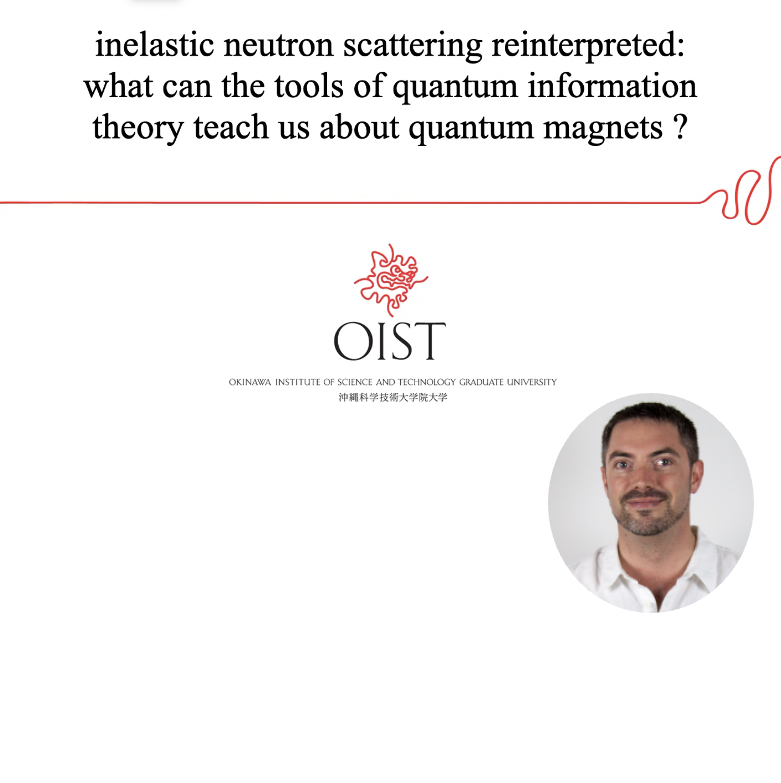
Speaker: Nic Shannon, OIST, Japan.
Title: Inelastic neutron scattering reinterpreted: what can the tools of quantum information theory teach us about quantum magnets?
Link to Link to the event page
This talk was given under the LINXS theme: Quantum Materials.
Abstract The very things which make exotic phases in quantum magnets interesting: the absence of conventional magnetic order parameters; the emergence of fractional excitations; their topological and entanglement properties, also make them difficult to distinguish in experiment. This is particularly true of quantum spin liquids, states which represent a "holy grail" of modern condensed matter physics, but which are notoriously difficult to diagnose, especially in the presence of disorder. In this talk we explore how ideas from quantum information could be used to distinguish quantum spin liquids from other competing phases of matter. We consider two problems where the possibility of finding a quantum spin liquid has been widely discussed: quantum spin chains, and triangular lattice antiferromagnets [1,2]. In both cases, we find that inelastic neutron scattering, interpreted in terms of quantum Fisher information, can be used distinguish quantum spin liquids from states driven by disorder. We also address some of the pitfalls which arise in the naive application of ideas from quantum information to quantum magnets. These results suggest that, used carefully, the tools of quantum information offer a powerful new way of interpreting the results of inelastic neutron scattering experiments. [1] S. Sabharwal, T. Shimokawa and N. Shannon, arXiv:2407.20797 [in press] [2] T. Shimokawa, S. Sabharwal and N. Shannon, arXiv:2505.11874 BIO Nic Shannon is a theoretical physicist specializing in condensed matter and statistical physics. His research focuses on quantum magnets and other forms of “quantum matter,” where large numbers of quantum particles interact. He received his education in the UK and held postdoctoral positions at the University of Wisconsin–Madison (USA), CEA Saclay (France), and the Max Planck Institute for the Physics of Complex Systems (Germany). In 2006, he was appointed to a permanent position at the University of Bristol (UK). In October 2011, he joined OIST, where he established the Theory of Quantum Matter Unit. The group uses a combination of analytical and numerical methods to investigate models motivated by experiments on a broad range of quantum materials. His research has been significantly shaped by time spent as a Guest Professor at the University of Tokyo, and he continues to collaborate closely with both physicists and chemists in Japan.