
First publication from the Antibodies in Solution research programme: Diffusion, Search and Attack Motions of Antibodies
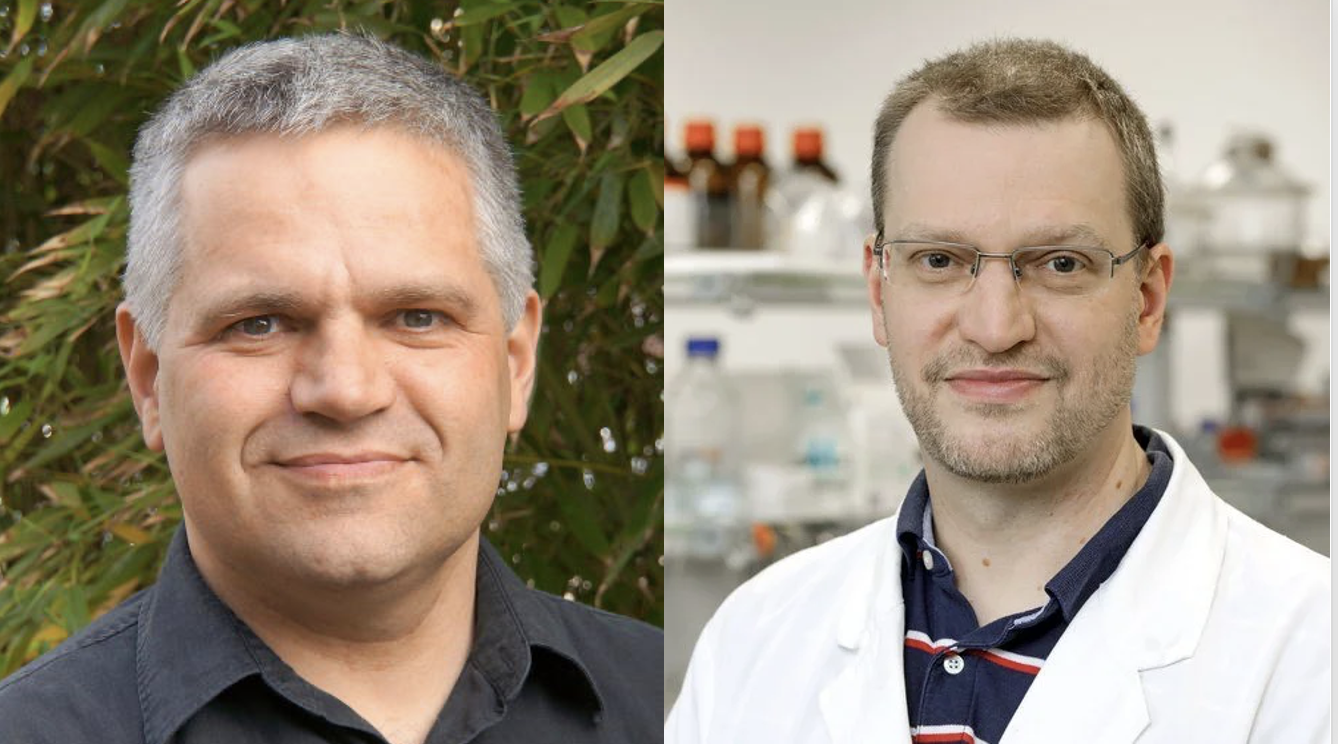
L-R: Ralf Biehl and Andreas Stadler. Ralf Biehl is a Senior Scientist and Andreas Stadler is a Senior Research Scientist at the Jülich Centre for Neutron Science, Forschungszentrum Jülich GmbH. They were both part of the Antibodies in Solution Research Programme at LINXS.
The Antibodies in Solution research programme has now yielded its first scientific publication, on the diffusion, search and attack motions of antibodies. The publication is based on experiments made with the antibody provided by the American National Institute of Standards and Technology (NIST).
The Antibodies in Solution program gathered 14 research groups, NIST, and the pharmaceutical company Novartis in Switzerland. It aimed to increase fundamental knowledge on how antibodies behave at higher concentrations. This knowledge can help the pharmaceutical industry to decide what antibodies they should use and how to formulate them to produce therapies that are easier to inject and administer for patients. Since it ended in late 2024, research has been ongoing in the various research groups.
LINXS spoke to two of the authors of the publication, entitled: Diffusion, Search and Attack Motions of Antibodies, and published in Communications Biology: Ralf Biehl and Andreas Stadler.
What are the publication’s key findings?
Antibodies have a characteristic structure of three fragments connected by a linker. The linker allows lateral movements and forward movements of the fragments which we name “search” and “attack” motions as they remind to “search” a binding position and to “attack” it for binding. If we increase concentration to physiological relevant like in blood or close to a virus surface where crowding becomes relevant, the search motions and rotational motions are suppressed while the functional important “attack” motions are still present.
The translational diffusion of the antibodies at increased concentrations can still be described by a simple spherical model that allows predictions for even larger concentrations for drug formulations. The results may be helpful for a strategic design of the linker region to enhance the therapeutic efficacy of monoclonal antibodies.
What was the role of the LINXS Antibodies programme in realising this publication?
The LINXS Antibodies programme connected us to other groups interested in antibodies and allowed a shared effort examining the same protein under the same conditions and to learn from each other. Our partners from NIST, in Washington, supported us with a huge amount of antibodies that was necessary for establishing stable conditions and all the experiments we performed using neutron scattering and lab-based methods.
What did you gain from being part of this programme?
We met with the other working groups from the LINXS Antibodies in Solution programme and had regular exchanges both in virtual form during the LINXS-NIST Webinar Series as well as during meetings that took place in Lund. It's great to see what they're interested in and how they approach similar problems. The LINXS Antibody in Solution program was part of two LINXS Research Themes: Dynamics and Integrative Pharmacology and Drug Discovery (IPDD). Due to the integration into the IPDD theme, Andreas Stadler could visit LINXS and Lund for two months in 2023 as a Guest Researcher. During that visit, he got a good impression of the academic life and scientific activities in Lund. He met many researchers who are connected to LINXS from different research themes. He still meet many of them during my experiments at neutron sources world-wide.
What are next steps in this research venture?
We still have data to analyse. We investigate the role of excipients on the dynamics or try to understand the connection between diffusion and macroscopic viscosity together with our partners. Both are important for drug formulations. We plan to extend the accessible timescales by using XCPS at XFEL with partners connected to the program. The method is similar to neutron spinecho spectroscopy- which we use- but works at longer times we cannot access. In particular, we will continue our fruitful collaboration with Prof. Anna Stradner and Prof. Peter Schurternberger from Lund University regarding the molecular dynamics of antibodies in solution.
What is the value of interdisciplinary science for antibody research in general?
We are working at the border of biology using advanced methods from physics, in our group mainly neutron scattering methods complemented by X-ray scattering, dynamic light scattering and PFG-NMR. Neutron scattering allows to access structure and dynamics at length and timescales that are difficult to access by other methods while the method is difficult to access for non-specialists. We're taking our methodology and expertise and applying them to the field of antibodies. This helps us understand how antibodies move and change their internal configuration. Our goal is to contribute to a physical picture of protein function helping to understand the biological implications.
Read more about the Antibodies in Solution final results and meeting