
Joint ESS and University of Leicester publication on the cancer drug SAHA and drug off target interactions
We are happy to share the first collaborative publication from the Chemistry of Life theme: on the cancer drug SAHA and off target drug interactions. It is a joint publication between ESS and the University of Leicester - authored by amongst others, theme members Zoë Fisher, senior scientist at the ESS, and James Hodgkinson, Associate Professor at the Institute of Structural and Chemical Biology and School of Chemistry, University of Leicester.
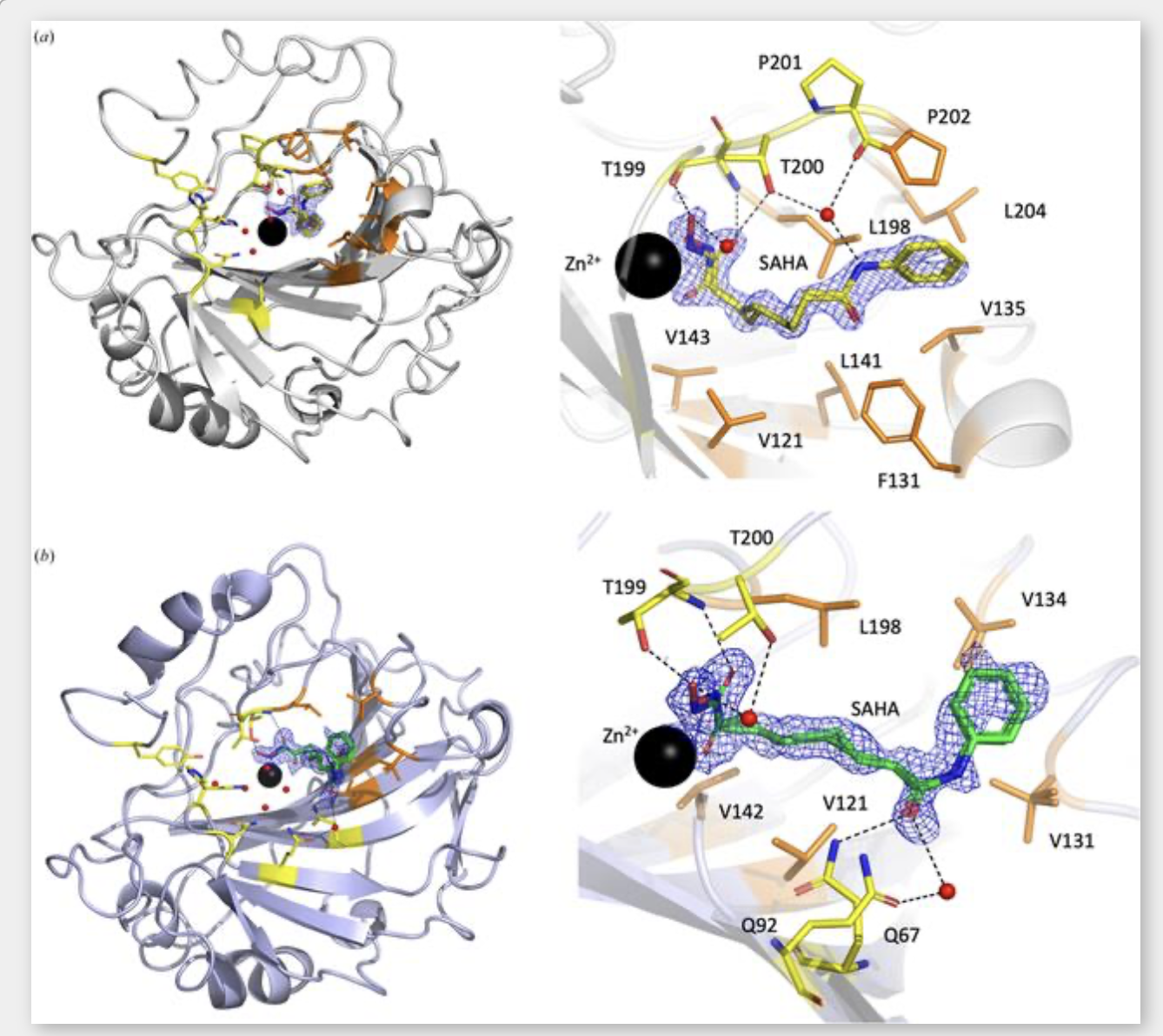
Figure 3
Binding interactions between CA and SAHA. (a) The CA II structure is shown as a gray cartoon; the active-site Zn2+ and water molecules are shown as black and red spheres, respectively. Active-site residues and SAHA are shown in yellow ball-and-stick representation. (b) The CA IX mimic structure is shown as a blue cartoon; the active-site Zn2+ and water molecules are shown as black and red spheres, respectively. Active-site residues and SAHA are shown in yellow and green ball-and-stick representation, respectively. Hydrophobic residues around the SAHA alkyl chain and benzene ring are shown in orange ball-and-stick representation. 2mFo − DFc electron density for SAHA is shown as a blue mesh and is contoured to 1.0σ in both panels. Hydrogen bonds are indicated by black dashed lines. Zinc ligands (His94, His96 and His119) and His64 are omitted for clarity. This figure was generated using PyMOL v.2.5.2 (Schrödinger).
Reference: doi: 10.1107/S2053230X25007447.
The publication is entitled: Off-target binding of the histone deacetylase inhibitor vorinostat to carbonic anhydrase II and IX, and is published in Structural Biology Communications.
We spoke to Zoë and James about the findings of the study, its genesis, and how they made use of each others’ expertise.
What are your most salient results?
This study focuses on the cancer drug SAHA (Vorinostat). It is primarily used for the treatment of cutaneous T-cell lymphoma (CTCL), a rare subtype of non-Hodgkin lymphoma. SAHA is primarily designed to inhibit histone deacetylases (HDAC) but our study shows it can also bind to, and potentially inhibit, carbonic anhydrases (CA) – enzymes involved in pH regulation and overexpressed in many solid tumor metastasis processes, over 30 identified so far, including breast, lung, cervical, and colorectal cancer. The results show two distinct binding modes at the zinc active site in CA.
These data indicate that SAHA might cause unintended off-target effects, which can include several serious adverse events. These include QTc prolongation, which can predispose to life-threatening arrhythmias; deep vein thrombosis (DVT) and pulmonary embolism (PE), both of which carry significant risk of morbidity and mortality; and thrombocytopenia, which can lead to bleeding complications.
These findings highlight the importance of understanding drug off-target interactions but also shows that hydroxamate-based compounds could serve as novel scaffolds for developing more selective inhibitors of carbonic anhydrases.
Drug specificity remains a very challenging issue for HDAC and CAs. Detailed structural studies help researchers understand some of the underlying molecular binding interactions and can inform drug design efforts to minimise these issues.
How did the collaboration come about?
We met through the LINXS Chemistry of Life theme which is a collaboration between Lund University, MAX IV, ESS, and Leicester University.
How did you make us of each other’s expertise/skill?
James has expertise in medicinal chemistry, Protacs and HDAC inhibitors, while Zoë is a structural biologist that has studied the structure-activity relationship in super fast enzymes like CA.
Since both HDAC and CA are Zinc-containing enzymes, it seemed like an interesting experiment to test whether the HDAC inhibitor SAHA could bind to CA. The first test with some of James’s experimental drugs failed to bind to CA, but then he suggested to try the clinically used ones and SAHA. After a difficult sample preparation to get the complexes, we collected very nice diffraction data at BioMAX (MAX IV) that allowed us to see the binding interactions clearly in the CA active site.
What is the value of working together like this?
Had we not met through the LINXS collaboration and had time to discuss HDAC active site and the known inhibitors, it is unlikely we would have met and been motivated to try some crystal soaks with this important class of HDAC inhibitors.
What scientific fields do you want to develop together in the future?
Lack of isoform specificity in clinically used drugs is a pervasive and challenging issue to solve. By combining expertise we can address this issue and use structures to inform on drug design and synthesis.
Cite the article:
Gulkis MC, Hodgkinson JT, Sele CP, Knecht W, McKenna R, Fisher SZ. Off-target binding of the histone deacetylase inhibitor vorinostat to carbonic anhydrase II and IX.
Acta Crystallogr F Struct Biol Commun. 2025 Sep 1;81(Pt 9):388-397. doi: 10.1107/S2053230X25007447.
Epub 2025 Aug 26. PMID: 40856436; PMCID: PMC12400194.