
LINXS engages children and senior citizens together with InfraVis at Culture Night at MAX IV
LINXS and InfraVis participated in MAX IV Laboratory Open Day Event on Saturday, 20th September as part of the yearly Culture Night event. It offered a great opportunity to present LINXS and InfraVis to members of the public in an engaging, interesting and innovative way – not least because science with X-rays and neutrons sometimes can seem abstract and hard to understand.
During the day, LINXS highlighted research from two of our themes: Heritage Science and Environment and Climate: we presented research about golden figures (from AD 700) found at the historical site Uppåkra with Heriage Science theme leader Mikael Fauvelle; research on mycelium: the root system of fungi which breaks down dead plants and turns them into nutrients with Environment and Climate theme leader Dimitrios Floudas; and research on foraminifera, single-celled organisms, which act as important living historical records as their fossilised shells can tell us a lot of how previous climates impacted the ocean with Helena Filipsson, core member of the Environment and Climate theme.

LINXS tattoo of a foraminifera is displayed on a visitor’s arm, with a brochure of Helena Filipsson’s research underneath. Picture: Katharina Beckmann.
Mikael Fauvelle is an archaeologist at the Department of Archaeology and Ancient History, Dimitrios Floudas is an associate senior lecturer at the Biology Department and Helena Filipsson is a Professor at the Geology Department. They all work at Lund University.
LINXS also gave away custom designed tattoos based on the two themes’ research.
From LINXS, postdoctoral fellow Daniel Sarabi and Co-Director Emanuel Larsson attended.
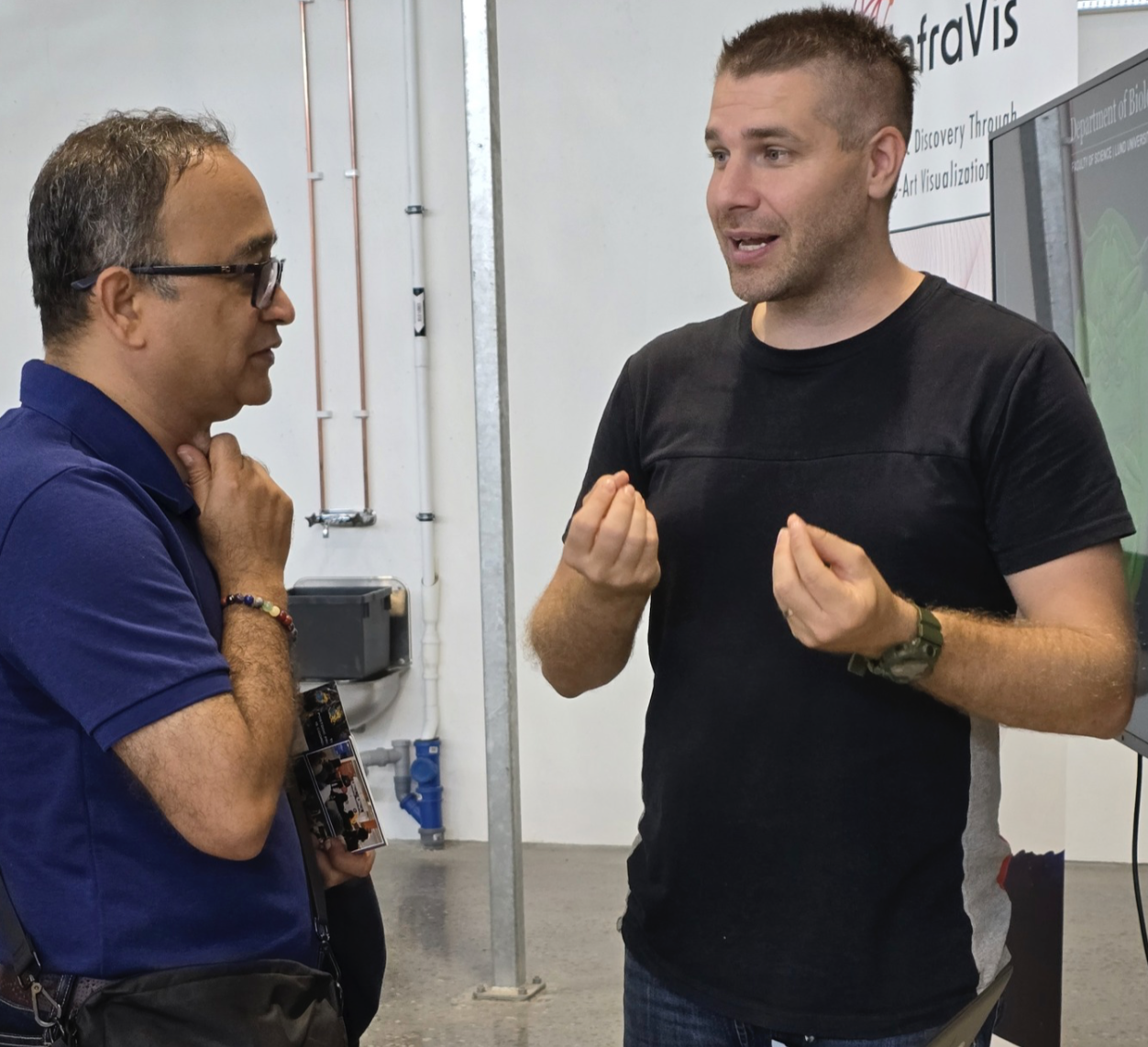
Emanuel Larsson (on the left) is talking to a man visiting the LINXS and InfraVis stand. Picture: Katharina Beckmann.
Daniel Sarabi says:
– Representing LINXS at MAX IV during Kulturnatten was a great experience. From curious children to engaged senior citizens, people from all walks of life came to explore how particle accelerators work. We had discussions about everything from the basic physics to the practical applications – how X-rays reveal the atomic structure of proteins and enable us to design new molecules to fight diseases.
– Engaging with such a diverse audience reminded me why public engagement in science matters. It’s about sharing knowledge, showing how fundamental research translates into real-world solutions, and giving people a glimpse into what usually happens behind closed doors.
Emanuel Larsson says:
– The combined LINXS and InfraVis booth attracted the attention of more than 300 visitors. The LINXS stickers tattoos, provided by the theme leaders Mikael Fauvelle, Heritage Science, and Dimitrios Floudas, Environment and Climate, served as interesting conversation starters, leading to engaging scientific discussions about applied science using X-rays. It was a great moment to spread info about LINXS and MAX IV, to both the public and to students from undergraduate to PhD level.