
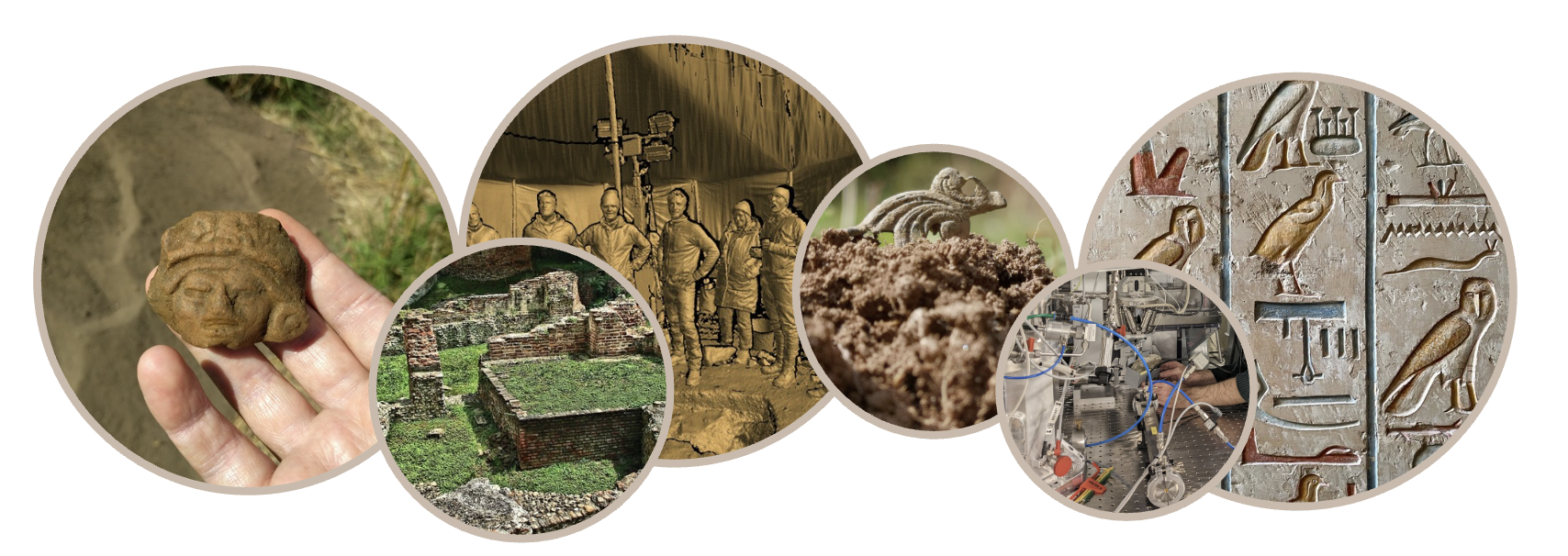
Want to learn more about techniques used for studying heritage science? Join us for LINXS Heritage Science Q&A!
When: 9 October, 2025, 14:00-17:00 (CET, Stockholm time!)
Where: Online via Zoom. A Zoom link will be sent out to all participants the day before the event. If you cannot find the email, please contact josefin.martell@linxs.lu.se
Cost: The event is free of charge.
About
This introductory workshop is intended for students and professionals who are interested in the use of advanced characterization methods in heritage science, but feel a bit lost as to where to begin! We have brought together a panel of experts, who use a range of x-ray and neutron techniques and apply them to the study of our natural and cultural heritage. This is a great opportunity to learn about a variety of techniques available to heritage students and professionals and have your questions answered by a friendly and knowledgeable group. You can read about each of our panellists below.
The workshop will consist of two sessions.
Session 1: each of our panellists will present the technique in which they specialise.
Session 2: Q&A. Questions can be submitted at any time or asked in the workshop. No preparation is needed. However, if you submit your question(s) by Sunday 28 September, they will be passed on in advance to the speakers and will therefore result in fuller answers on the day.
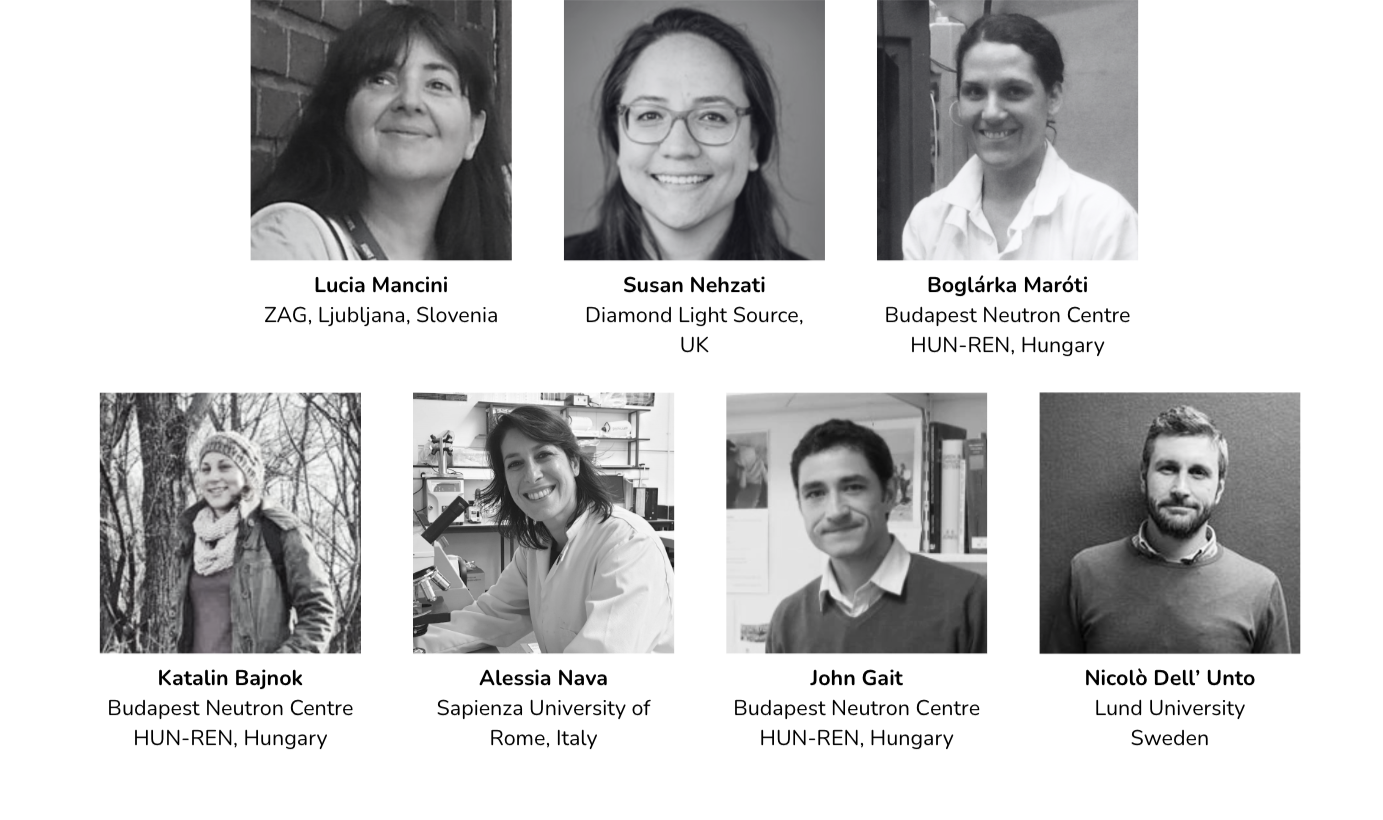
Expert panellists
(read more about the speakers and their talks below)
-
Schedule (please note that the times are in CET/GMT+1)
14:00–14:10: Introduction to the workshop
14:10–15:20: Session 1: Learn about techniques in Heritage Science studies
14:10–14:20: Lucia Mancini, Slovenian National Building and Civil Engineering Institute, Slovenia
14:20–14:30: Nicolo dell Unto, Lund University, Sweden
14:30-14:40: Susan Nehzati, Diamond Light Source, UK
14:40-14:50: Boglarka Maroti, Budapest Neutron Centre, HUN-REN Centre for Energy Research, Hungary
14:50-15:00: John Gait, Budapest Neutron Centre, HUN-REN Centre for Energy Research, Hungary
15:00-15:10: Katalin Bajnok, Budapest Neutron Centre, HUN-REN Centre for Energy Research, Hungary
15:10-15:20: Alessia Nava, Sapienza University of Rome, Italy
15:20-15:45: 25-min break
15:45-17:00: Session 2: Q&A and discussion
-
Lucia Mancini -Slovenian National Building and Civil Engineering Institute (ZAG), Ljubljana, Slovenia
In the last two decades, the ability to perform ex situ or in situ observation using hard X-ray imaging techniques has increased dramatically. In particular, X-ray microradiography and computed microtomography can be applied in many fields from biomedicine to materials science, from geology to heritage science studies, both using synchrotron- and advanced laboratory-based X-ray sources.
Earth scientists and (bio)archaeologists have recently developed analysis protocols suitable to investigate and quantify microstructural features of several materials (i.e. ceramics, glass, stone, wood, ancient bones and teeth) to extract precious historical and evolutionary information but also for restoration purposes, economic evaluation, and fabrication of replicas.
Research as well as applications in the fields of conservation and storage can benefit from the non-destructive character of these techniques allowing to investigate the external and internal features of an object in the three-dimensional (3D) domain working in static and dynamic (4D = 3D + time) conditions. The basic principles as well as advantages and limitations of these techniques, when applied to natural and cultural heritage studies, will be illustrated together with state-of-the-art methods of image visualization and quantitative analysis.
Several case studies will be used to better illustrate the potential of modern 3D/4D methodologies applied to heritage sciences.
Susan Nehzati - Diamond Light Source, Harwell Science and Innovation Campus, Didcot, UK
Synchrotron X-ray techniques allow scientists to investigate deep inside materials with enhanced chemical and spatial details. A key advantage of synchrotron radiation is its compatibility to study historical objects using non-destructive analysis where keeping them intact is a top priority.
Diamond Light Source is the UK’s national synchrotron science facility offering methods in chemical identification and advanced imaging techniques (2D, 3D, and 4D) to learn more about the structure and composition of materials. Some of the main techniques I work with include:
X-ray fluorescence imaging (XRF): showing elemental distribution
X-ray absorption spectroscopy (XAS): revealing local chemical information
X-ray diffraction (XRD): identifying chemical information of ordered materials
X-ray emission spectroscopy (XES): examining chemical information at improved sensitivity.
In the field of Heritage Science, these tools help researchers in a variety of applications which include studies on the preservation of cultural artifacts, best practices to mitigate damage, and uncovering historical narratives.
Boglárka Maróti - Budapest Neutron Centre, HUN-REN Centre for Energy Research, Budapest, Hungary
Neutron-based analytical techniques offer a wide range of applications for the materials science investigation of cultural heritage artefacts, including artefacts made of stone, ceramics, glass, metal, as well as composite objects. For many techniques, analyses are completely non-destructive with measurements made in situ without invasive sampling, and due to the depth of penetration (even up to 10–15 mm, and considerably greater than X-rays) can provide sub-surface and bulk measurements.
This presentation will illustrate the application of prompt gamma activation analysis (PGAA), and time-of-flight neutron-diffraction (TOF-ND), together with imaging, to investigate metal artefacts, such as macroscopically heterogeneous casting ingots or spearheads with wooden shaft remains. PGAA may be used to determine elemental composition through simultaneous irradiation of a target area with low energy neutrons and measurement of emitted ɣ-photons. PGAA is not affected by corrosion products covering the surface of metal objects, and may be combined with neutron and/or X-ray imaging to provide 2D or 3D spatially resolved information on internal structure and elemental composition. PGAA measurements are often combined with TOF-ND that uses the diffraction of neutrons by a sample to measure its crystalline structure. For metals, this may be used to differentiate phases and determine the possible production technology of the object. The application of these techniques together with their strengths and limitations will be discussed, alongside the complementary technique of p-XRF, as well as how to properly interpret the results from analyses conducted at different spatial scales.
Katalin Bajnok - Budapest Neutron Centre, HUN-REN Centre for Energy Research, Budapest, Hungary
This presentation introduces small-angle neutron scattering (SANS) for the non-destructive and quantitative analysis of the primary forming techniques of ancient pottery. In a similar manner to submillimetre-scale objects used in tomographic imaging analysis (see previous presentation), SANS may be used to identify forming techniques by measuring the orientation of nanoscale scattering domains within the fabrics of pottery sherds. By measuring the magnitude and direction of anisotropy in 2D coherent neutron scattering within a specified volume of a sample, the mean orientation of nanoscale domains may be measured, and in turn correlated with categories of forming techniques (e.g. wheel-throwing, coil-building, percussion-building). The scattering domains themselves range in length from c. 10 to 100 nm, and predominantly represent particles and pores (or parts of larger objects) within the clay-rich matrix of the pottery fabrics.
By measuring the orientation of nanoscale domains, SANS may be used for both coarse- and fine-textured pottery fabrics. Accordingly, this has a significant advantage over tomographic imaging approaches that require the presence of comparatively larger particles or voids.
This presentation will describe the practical requirements of SANS measurements, and present results from modern experimental replica pottery and ancient pottery. Comparisons between 2D data from SANS and 3D data from tomographic imaging will also be discussed, alongside their respective strengths and limitations.
Alessia Nava - Sapienza University of Rome
Teeth of humans and other mammals act as faithful biological archives. Their mineralised tissues – enamel, dentine, and cementum – preserve detailed information about an individual’s development, recording growth rates, physiological stress, dietary changes, and mobility during tooth formation. Due to their durability, teeth are among the most frequently recovered and best-preserved elements in the fossil record. However, their rarity often limits the use of destructive analytical methods.
Advances in non-destructive, high-resolution imaging – such as X-ray microtomography and synchrotron-based techniques – have revolutionised the study of ancient dental remains. Phase Contrast Synchrotron X-ray microtomography enables to perform the so-called virtual histology, which allows the visualization of the microscopic markers of dental mineralised tissues growth. This technique allows the reconstruction of growth patterns and the detection of stress events from the prenatal period through adolescence by analysing internal features of enamel and dentine. Cementum, meanwhile, can be used to investigate physiological stress during adulthood and offers a means of estimating age at death when other skeletal indicators are lacking.
This contribution presents selected case studies applying conventional and synchrotron microtomography to fossil and subfossil teeth of Neanderthals and Homo sapiens. These investigations provide valuable insights into the life histories of past humans and contribute to a more nuanced understanding of their developmental and physiological experiences.
John Gait - Budapest Neutron Centre, HUN-REN Centre for Energy Research, Budapest, Hungary
This presentation focuses on recent advances in the application of tomographic imaging (with either X-ray or neutron sources) for the non-destructive and quantitative analysis of the primary forming techniques of ancient pottery. While X-ray radiography and X-ray microtomography (µ-CT) have been used for some time within archaeological pottery studies to investigate fabric composition and forming techniques, the results have tended to be qualitative and subjective, often focusing on large-scale macroscopic features (e.g. coil-joins).
This presentation describes how more advanced quantitative approaches may be used to analyse entire vessels or sherds, using the 3D orientation of millimetre- to submillimetre-scale objects within pottery fabrics. During pottery production, as the unfired clay-paste is manipulated to form vessels, particles (including organic inclusions) and voids become orientated in characteristic patterns according to the types of forming techniques used (e.g. wheel-throwing, coil-building, percussion-building). Significantly, as the orientation of objects are minimally affected by secondary forming or later stages of production, this approach may be applied to a wide range of pottery wares.
The practical application of this approach will be briefly introduced, including comparative data from experimental replica vessels alongside archaeological case studies, as well as techniques for analysing and presenting results using a spherical coordinate system and circular statistics.
Nicolò Dell’ Unto - Department of Archaeology and Ancient History, Lund University
This presentation examines how 3D visualization is contributing to a shift in archaeological practice, moving beyond static representation toward more dynamic and reflexive forms of engagement with data.
The Dynamic Collections platform is presented as a case in which the affordances of interactive environments support not only new modes of visualization but also new epistemic routines, enabling collaborative interpretation, iterative annotation, and structured reuse. Additional examples from digital archives are examined to explore how shifting technical infrastructures relate to broader transformations in archaeological practice.
Emphasis is placed on the idea that the development of new digital tools must be accompanied by an equally active effort to establish and sustain new practices. Rather than treating technology as a neutral enabler, the talk highlights the co-dependence of tools and practices, and argues that their mutual adaptation is essential to ensuring both methodological innovation and long-term impact.
Contact
For practical questions, please contact josefin.martell@linxs.lu.se
If you don’t receive a registration confirmation please check your spam mail.
During our events we sometimes take photographs and short film clips to profile our activities. Please let us know if you don’t want to be in any photos/films before we start the event. Some webinars are recorded to be used for educational purposes in the LINXS website.
By registering to our events you give your permission to LINXS, according to the General Data Protection Regulation (GDPR), to register your name and e-mail address to be used for the sole purpose of distributing newsletters and communications on LINXS activities.