
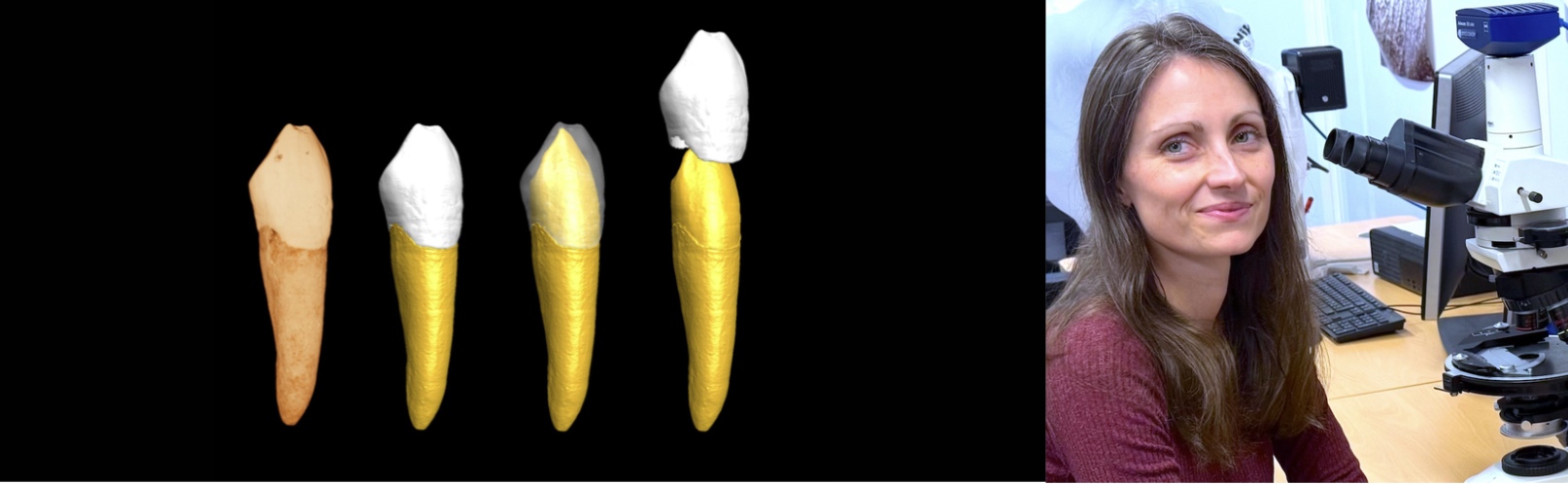
Tooth image credit: Martina Trocchi & Alessia Nava, Sapienza University of Rome, Italy
When: 17 November, 2025, 15:00 - 16:00 CET
Speaker: Clarissa Cagnato, Archéologie des Amériques, France
Title: Synchrotron radiation X-ray computed microtomography (SR-μCT) as a technique for studying ancient carbonized foods
Abstract
In the context of archaeology, seeds and other plant components are frequently unearthed in association with the preparation, consumption, and discarding of food. While seeds and other plant components can be identified to a certain extent, amorphous carbonized objects (ACOs) can also be recovered through flotation. A thorough examination of the ACO surfaces under a binocular microscope typically fails to reveal any identifiable components. Consequently, these materials are most often classified as 'unidentified' or 'unknown', set aside and not investigated further. However, studies have demonstrated that their meticulous research can provide valuable insights into past culinary practices, including the ingredients used in the elaboration of recipes.
The objective of this webinar is to present the experimental work undertaken to enhance comprehension of ACOs recovered from pre-Hispanic Mesoamerican contexts (A.D. 250–900). The webinar will cover the replicative experiments conducted to create a reference collection, including exposure to varying thermal conditions and different heat durations. Subsequently, a series of non-destructive imaging techniques were employed for analysis. These techniques included optical microscopy, scanning electron microscopy (SEM), laboratory-based computed microtomography (μCT), and synchrotron radiation X-ray computed microtomography (SR-μCT). A portion of the webinar will be dedicated to discussing the considerations that must be taken into account when contemplating beamtime on carbonized organic remains.
Overall, the webinar will highlight the merits of studying ACOs. The integration of these techniques has the potential to yield diagnostic elements and features, thereby facilitating a more profound comprehension of the microstructure of ancient Mesoamerican foods and those from other regions.
Biography
Clarissa Cagnato is an archaeobotanist interested in reconstructing ancient diets and plant use through the recovery and study of macro- and microbotanical remains. She received her Ph.D. from Washington University in St. Louis, Missouri. Since then, she has collaborated on various projects ranging from determining the diets of Paleolithic and Early Neolithic populations living in Eurasia to documenting Iron Age food practices in western Central Africa. She recently completed a Marie Skłodowska-Curie postdoctoral fellowship at Ca’ Foscari University of Venice. There, she developed COMAL, a project studying ancient Mesoamerican cuisine using imaging approaches.
If you don’t receive a registration confirmation please check your spam mail.
During our events we sometimes take photographs and short film clips to profile our activities. Please let us know if you don’t want to be in any photos/films before we start the event. Some webinars are recorded to be used for educational purposes in the LINXS website.
By registering to our events you give your permission to LINXS, according to the General Data Protection Regulation (GDPR), to register your name and e-mail address to be used for the sole purpose of distributing newsletters and communications on LINXS activities.