
X-rays shed new light on ‘guldgubbar’ from Uppåkra
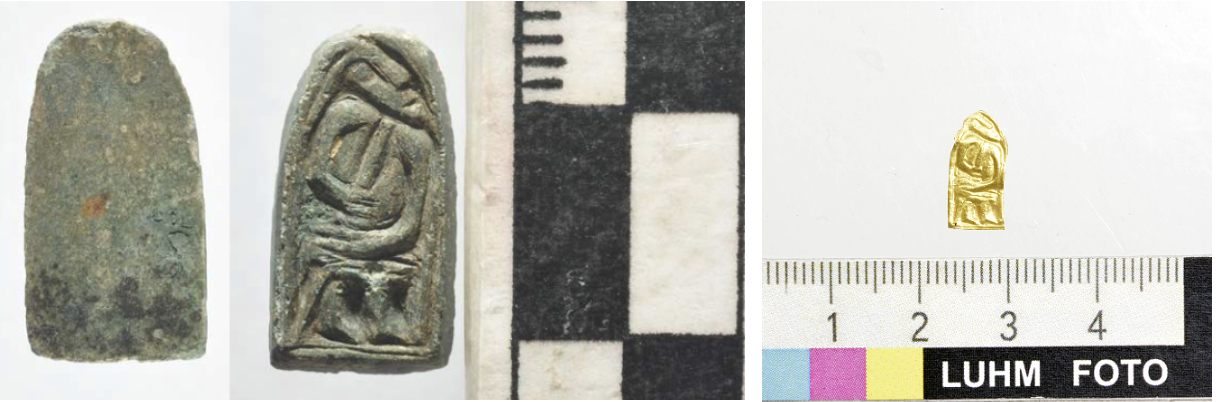
The pictures show (left) an image of the patris that was studied at MAX IV and (right) a matching guldgubbe.
New X-ray experiments performed by Heritage Science theme leader Mikael Fauvelle reveal how some of the gold figures found at the iron-age settlement Uppåkra actually consist of electrum, a mixture of both gold and silver. These findings suggest how chieftains could have struggled to obtain gold, which at the time symbolised social status and affluence, according to Mikael and his team.

Mikael Fauvelle says it is an exciting time to work in archaeology. That one can study complex composite materials and find out more about their chemistry and origin opens for new possibilities.
At Uppåkra, the four year project “Uppåkra – the Hall on the height” 2022-2026 has yielded new information about this power centre, under leadership of professors Mats Roslund and Torbjörn Ahlström.
– The use of electrum makes one ponder interactions with continental Europe. What makes the findings even more interesting is that similar figures have been found in Blekinge, Sweden, but these are made out of more pure gold, says archaeologist Mikael Fauvelle, researcher at the Department of Archaeology and Ancient History, Lund University.
The Uppåkra site in Skåne, Sweden was founded around 100 BCE and became one of northern Europe’s largest settlements. It was an important residence with a manor and cult centre until it was abandoned just before AD 1000.
Excavations on the site is ongoing since many years. One of most significant findings consist of roughly 120 ‘guldgubbar’, gold figures, from the late 6th and 7th century, which is the most found at any site in Sweden. They were found in the wall trenches and postholes of the cult house in the residence, and their tiny size suggest that they were used for a religious purpose, maybe as signs of agreements and legal arrangements between peers supervised by the god. Most of them depict male figures, whereas some depict females or female-male couples.
Now Mikael Fauvelle and Mats Roslund’s recent X-ray experiments at MAX IV reveal how some of the gold figures were not actually made of gold foil, but rather electrum, which is a mixture of gold and silver. By performing experiments on the moulds which were used to stamp out the figures, they found that the tiny specks of yellow found inside the moulds were electrum. The initial aim with the experiments was to match the specks with the gold figures found at Uppåkra: to ascertain that the moulds were in fact used to make them.
– That we are able to now image artefacts down to the nanometer scale reveals hitherto unknown facts about sites such as Uppåkra. It is highly interesting that some of the gold figures are made out of electrum, says Mikael Fauvelle.
According to Mikael Fauvelle this can suggest that chieftains in Uppåkra might not have had opportunity to acquire fortunes in Byzantium or in the region of the western Roman empire – as they had to debase the gold with silver. At the time gold was a symbol of social status; something you traded with and used to establish yourself as an important person.
Another interesting fact is that gold figures found in Blekinge, on the east coast of Sweden, from the same period, are not debased.
– This can suggest that warriors from Blekinge were obtaining gold from different places than those who travelled from Uppåkra. I see these results as the start of further research, says Mikael Fauvelle.
He continues:
– It is such an exciting time to work in archaeology. To be able to study complex composite materials and to find out more about their chemistry and origin, really opens up new possibilities.