
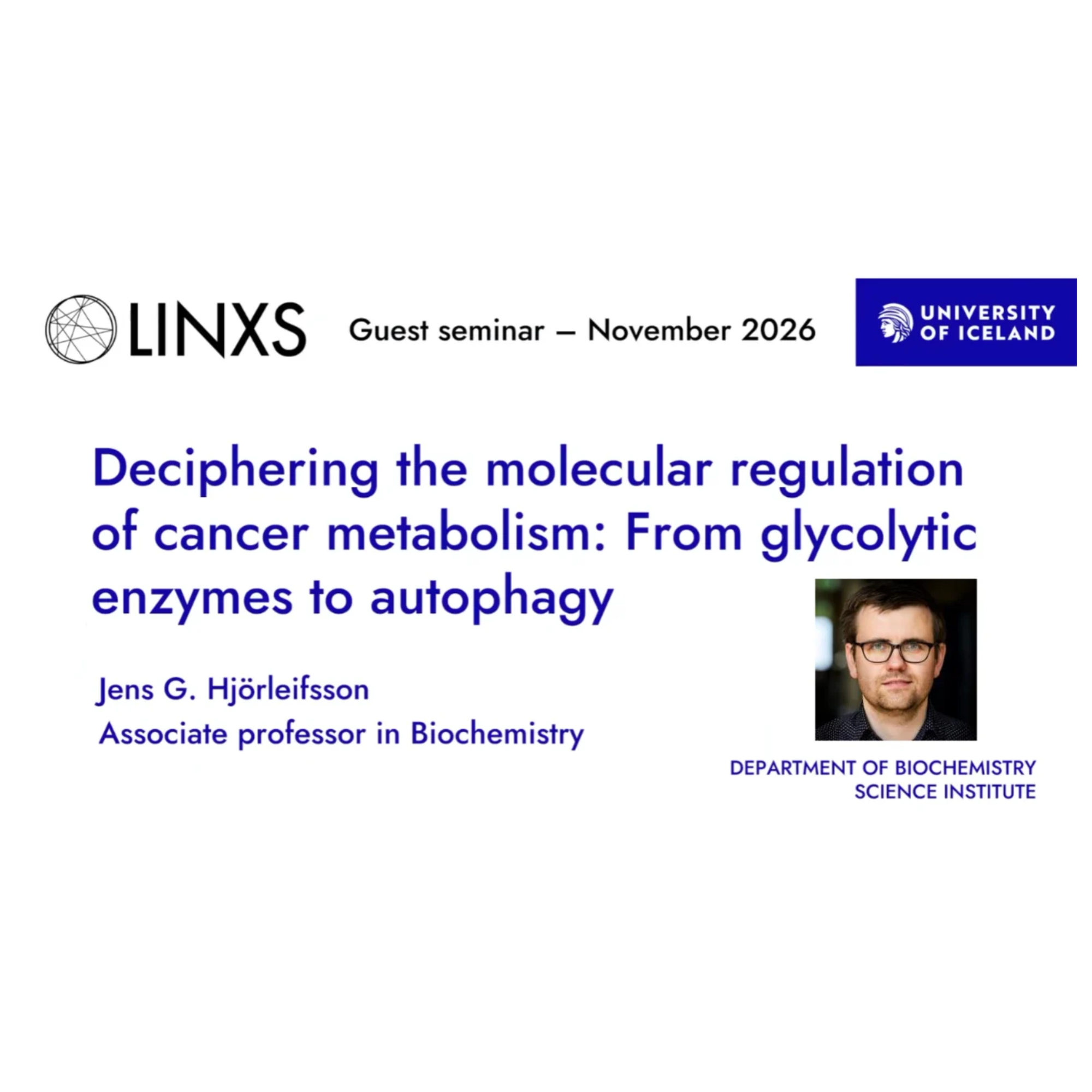
Deciphering the molecular regulation of cancer Metabolism: From glycolytic enzymes to autophagy with Jens G. Hjörleifsson
This talk explores how concepts from colloid science can help us better understand protein solutions, focusing on their stability, phase behaviour, dynamics and interactions.
Speaker: Jens G. Hjörleifsson, Assistant Professor of Biochemistry at the Faculty of Life and Environmental Sciences, University of Iceland
Abstract: Cancer cells undergo extensive metabolic reprogramming to sustain proliferation, adapt to nutrient limitations, and survive cellular stress. Two central components of this adaptation are glycolysis, which provides energy and metabolic building blocks, and autophagy, which enables the recycling of cellular components and maintenance of metabolic homeostasis. Understanding the molecular mechanisms underlying these processes offers opportunities to identify new regulatory mechanisms and potential therapeutic targets.
In this seminar, I will present recent work on the structural and biochemical characterization of human glycolytic enzymes, with particular emphasis on glucose-6-phosphate isomerase (GPI) and triosephosphate isomerase (TPI). Despite their central roles in metabolism, these enzymes have received relatively little attention as targets for pharmacological modulation. By combining enzyme kinetics, biophysical binding assays, X-ray crystallography, and structure-based virtual screening, we have identified previously unrecognized interactions between these enzymes and small-molecule metabolites, revealing new insights into their ligand recognition and potential regulation. More recently, fragment-based crystallographic screening at MAX IV has uncovered multiple previously unexplored ligand-binding pockets, including sites distant from the catalytic centers, opening new possibilities for the development of allosteric modulators.
I will also introduce ongoing collaborative research on the autophagy-related protein ATG7, focusing on the structural and functional characterization of its human isoforms and their molecular interactions. This work aims to better understand the molecular machinery governing autophagy and its involvement in metabolic adaptation in pancreatic cancer.
Together, these projects highlight how integrative structural biology and biophysical approaches can help uncover molecular mechanisms of metabolic regulation, providing new perspectives on the complex relationship between cellular metabolism, autophagy, and cancer.
Biography: Jens G. Hjörleifsson is Assistant Professor of Biochemistry at the Faculty of Life and Environmental Sciences, University of Iceland. He studies how protein structure, dynamics and interactions govern function, combining enzyme kinetics and solution biophysics with X-ray crystallography and small-angle X-ray scattering. He earned his PhD at the University of Iceland on ionic effects and subunit interactions in a cold-active alkaline phosphatase, after an MSc in peptide and protein chemistry at Stockholm University. His group works on allosteric regulation of human metabolic enzymes, protein-protein interactions in autophagy and cancer, and affinity-based tools for isolating engineered extracellular vesicles, work that led him to found the start-up Affineva.