
Replication organelles of arboviruses through the lens of a cryo-EM with Lars-Anders Carlson
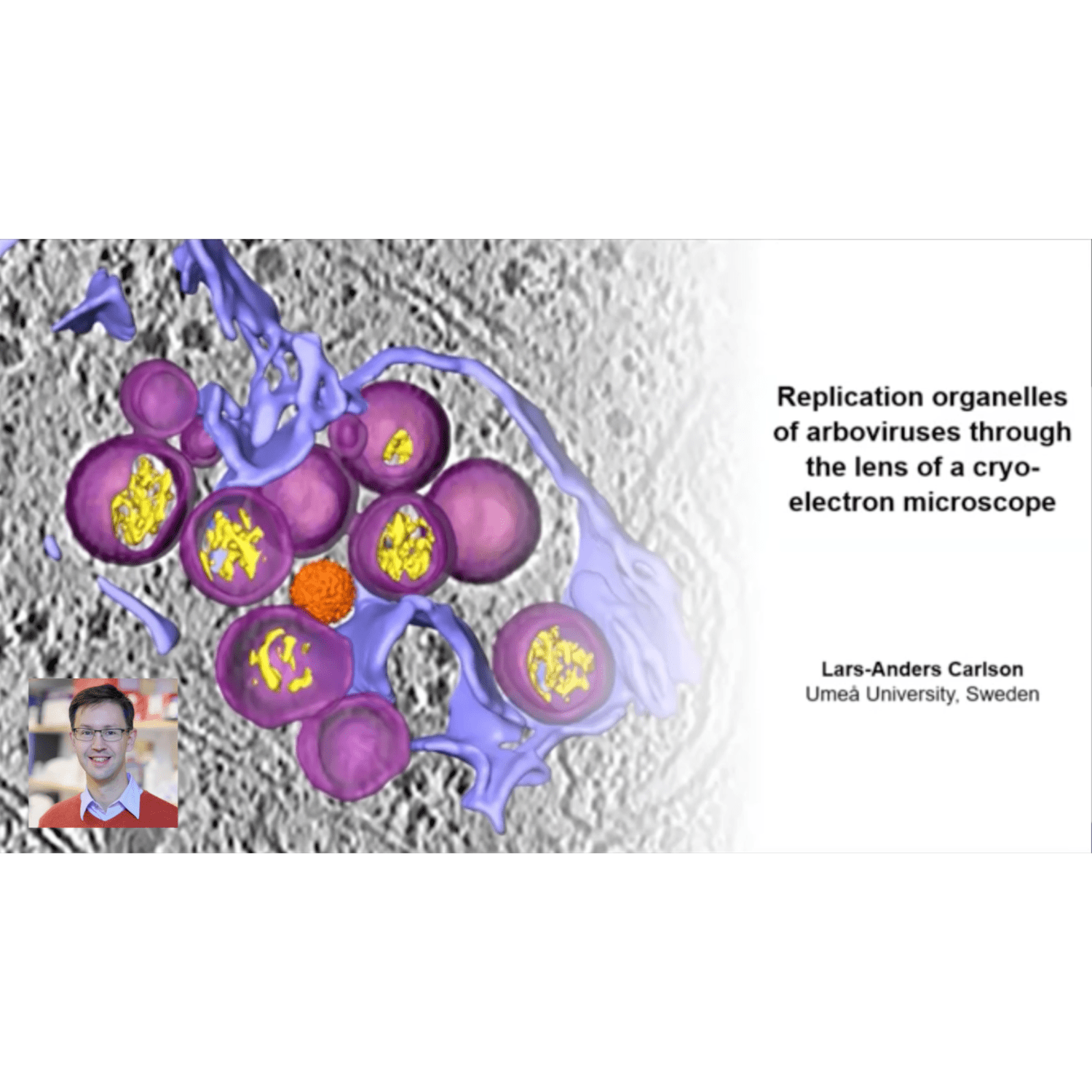
Speaker: Lars-Anders Carlson, Umeå University, Sweden
Abstract: Many arthropod-borne pathogens are positive-sense RNA viruses. Such viruses replicate their RNA on remodelled cytoplasmic membranes, in membrane-bound viral replication organelles. These replication organelles frequently take the shape of a 50-100 nm, stable membrane bud housing viral enzymes and template RNA.
Here, I present our cryo-electron tomography studies of replication organelles from two arthropod-borne virus types - alphaviruses and flaviviruses - with a focus on their macromolecular architecture and biophysical principles of their biogenesis. Alphaviruses, which hijack the plasma membrane to generate replication organelles, gather all the enzymatic activities necessary for genome replication in a 2 MDa protein complex located at the membrane bud neck. This complex further serves to constrain the bud neck, and the membrane budding then relies on the pressure generated from dsRNA polymerisation. This is thus a unique case of polymerase-mediated membrane remodelling. Flaviviruses generate replication organelles on a remodelled ER membrane using very different proteins from alphaviruses. They remodel the replication organelle membrane by a mechanism that relies both on a membrane coat, and on intraluminal pressure from viral dsRNA. In addition, I discuss the close coupling between flavivirus genome replication, virion budding and virion maturation.
Biography: Lars-Anders Carlson is a researcher and teacher at the Department of Medical Biochemistry and Biophysics. His research group studies how viruses remodel the cells they infect. Their main focus is on the dramatic changes that positive-strand RNA viruses can induce in host cell membranes within just a few hours.
Positive-strand RNA viruses are a large group of viruses responsible for a wide range of diseases, including the common cold, COVID-19, and tropical fever diseases such as chikungunya, dengue, and Zika fever. All viruses in this group replicate their genetic material by hijacking host cell membranes and reshaping them into so-called “virus factories,” often referred to as replication complexes.
The group uses a variety of biophysical, biochemical, and cell biological methods to understand, at the molecular level, the structure and function of these replication complexes. Their research has a strong focus on microscopy techniques, specifically fluorescence microscopy and cryo-electron microscopy.