
Science at the research neutron source Heinz Maier-Leibnitz (FRM II)
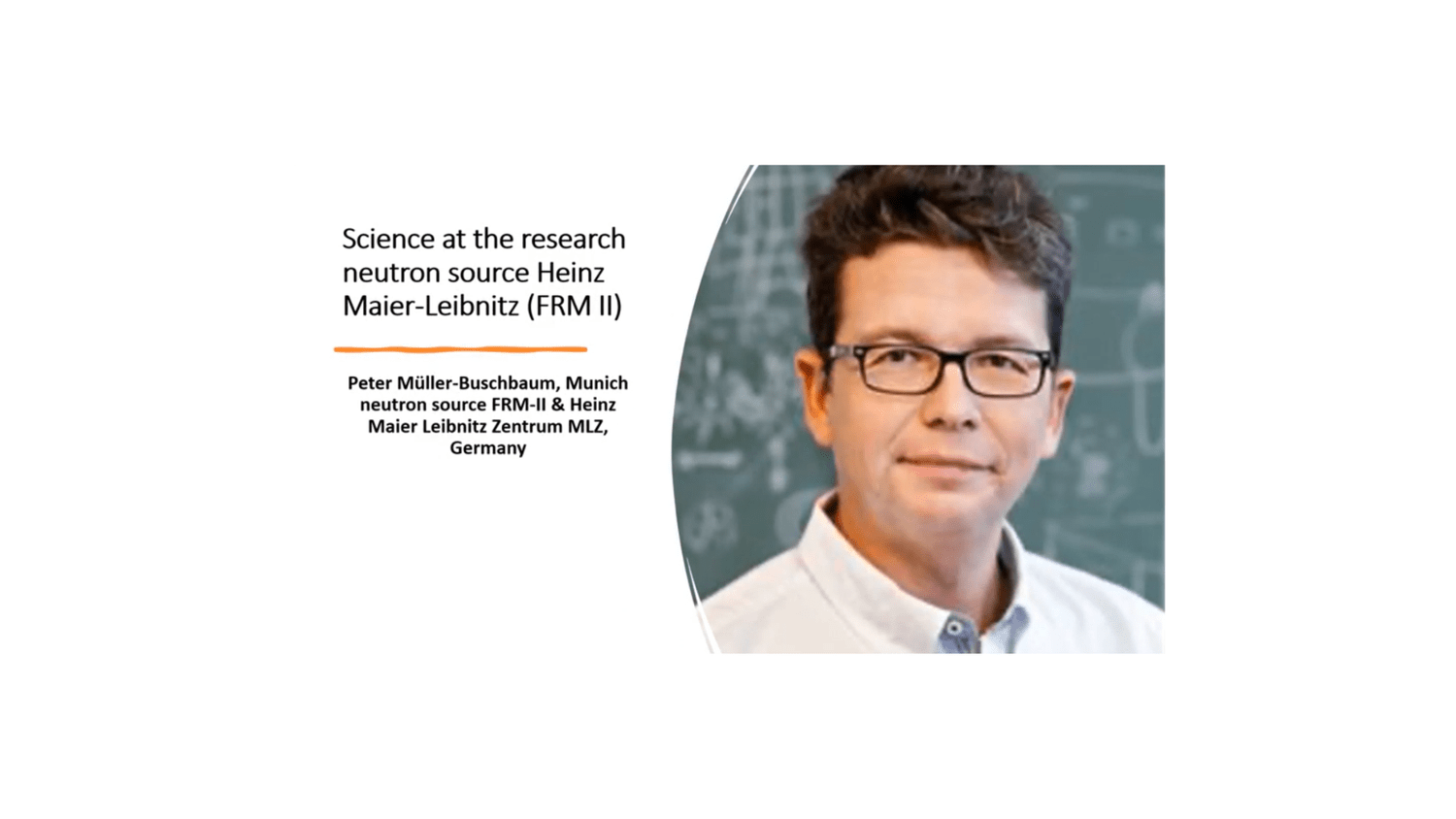
Speaker: Peter Müller-Buschbaum
Abstract: The research neutron source Heinz Maier-Leibnitz (FRM II) is a central scientific institute of the Technical University of Munich (TUM) located at the Research Campus in Garching. The FRM II came into user operation in April 29, 2005 and provides neutrons for science, industry and medicine in up to four cycles of 60 days a year. The Heinz Maier-Leibnitz Zentrum (MLZ), a cooperation TUM and research centers of the Helmholtz Association, Forschungszentrum Jülich and Helmholtz-Zentrum Hereon, organizes the scientific use of FRM II. By offering a unique suite of high-performance neutron scattering instruments, scientists are encouraged and enabled to pursue state-of-the-art research in diverse fields as physics, chemistry, biology, earth sciences, engineering or material science.
Biography: Prof. Dr. Peter Müller-Buschbaum studied physics in Kiel and received his doctorate there in 1996. He then worked as a postdoctoral fellow at the Max Planck Institute for Polymer Research in Mainz and as visiting scientist at the Institut Laue-Langevin and the European Synchrotron Radiation Facility in Grenoble, France. He acquired his postdoctoral teaching qualification (Habilitation) in 2002 and headed the Chair of Functional Materials at the TUM Department of Physics, before his appointment in 2018 as full professor, scientific director of the Munich neutron source FRM-II and scientific director of the Heinz Maier Leibnitz Zentrum MLZ. Since 2011, he has been the German representative at the European Polymer Federation and, since 2012, Associate Editor of the journal ACS Applied Materials & Interfaces. He also heads the Bavarian key laboratory TUM.solar and the Network for Renewable Energies (NRG) of the Munich School of Engineering (MSE). His research interests cover polymer and hybrid materials for energy and sensing applications with a special focus on thin films and nanostructures, including kinetic, in situ, and in operando experiments.