
Using colloid models for the description of protein solutions – an experimentalists approach with Peter Schurtenberger
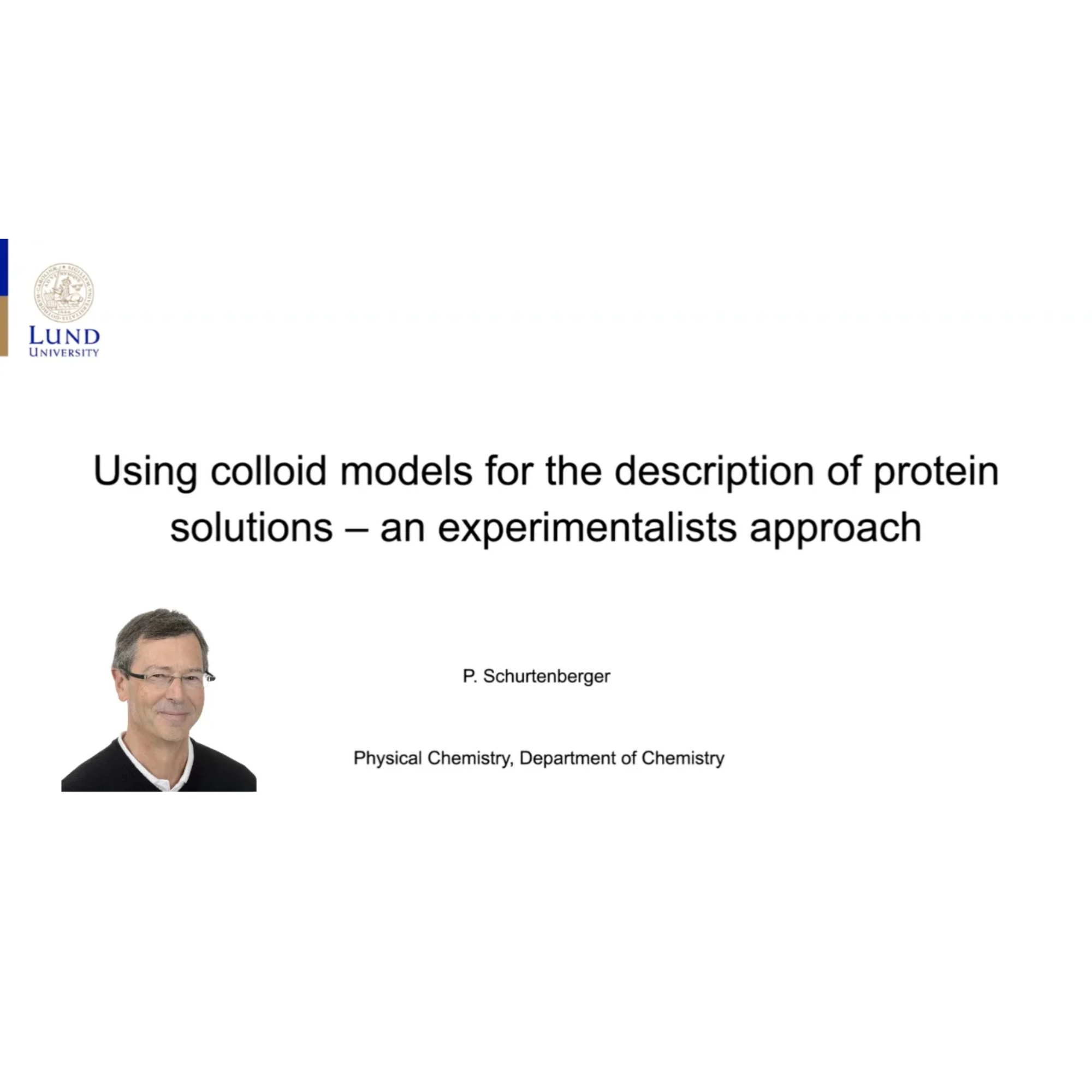
Speaker: Peter Schurtenberger, Lund University
Abstract: Looking at globular proteins with the eyes of a colloid scientist has a long tradition, in fact a significant part of the early colloid literature was focused on protein solutions. However, it has also been recognized that proteins are much more complex than the typical hard sphere-like synthetic model colloids. Proteins are not perfect spheres, and their interaction potentials are in general not isotropic, and using theories developed for such particles are thus clearly inadequate in many cases. Here I will make an attempt to critically discuss the exploitation of colloid science concepts to better understand protein solutions. I will not only consider classical applications aimed at understanding and predicting solution stability and phase behaviour, but also discuss new challenges related to the dynamics, flow behaviour and liquid-solid transitions found in concentrated or crowded protein solutions. I will demonstrate the importance of using a toolbox of techniques allowing for the characterisation of protein solutions over a broad range of length and time scales (static and dynamic light scattering, small-angle X-ray scattering, neutron spin echo and X-ray photon correlation spectroscopy, tracer particle-based microrheology), and highlight the limits of simple colloid models to explain and reproduce the experimental data. I will in particular address the interplay between liquid-liquid phase separation and dynamical arrest in concentrated protein solutions and mixtures, and the influence of shape and surface heterogeneity on the solution properties of monoclonal antibodies.
Biography: Peter Schurtenberger is Professor Emeritus of Physical Chemistry at Lund University, Sweden. He founded LINXS Institute of Advanced Neutron and X-ray Science in 2017 and served as its director from 2017 to 2018. His research focuses on colloid science, soft matter, and nanoscience, particularly the interactions and self-assembly of colloidal particles.