
Why Do We Like Research Infrastructures? Architecture, Knowledge Production, and the Public Imagination of Science with Gaia Sebastiana Ferraro
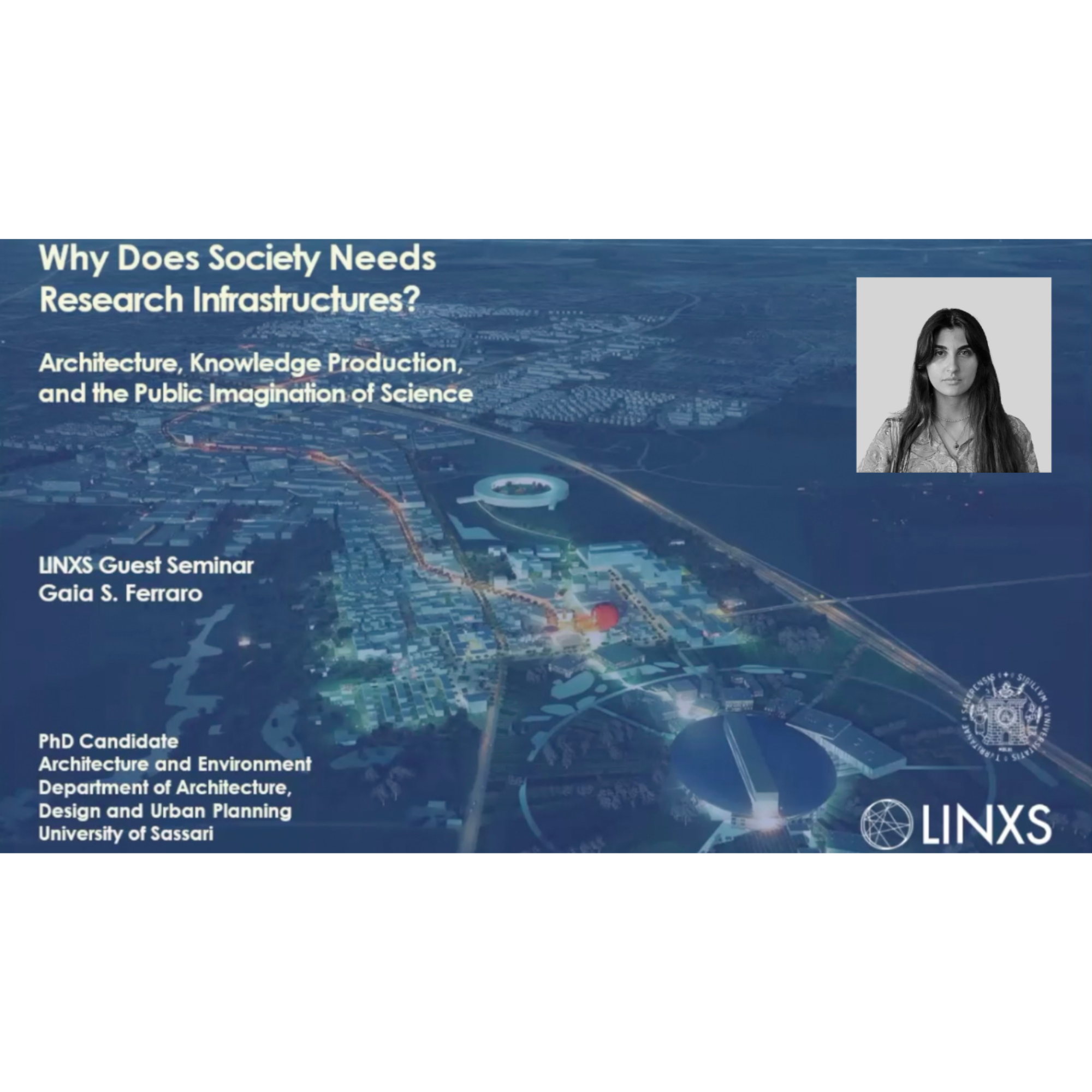
Speaker: Gaia Sebastiana Ferraro, University of Sassari, Italy
Abstract: Large Research Infrastructures are commonly understood as technological platforms designed to enable scientific discovery. Yet their significance extends far beyond their technical capabilities. Through their spatial organization and relationship with the surrounding territory, these facilities shape not only how science is conducted, but also how scientific knowledge is perceived, experienced, culturally represented and and ultimately transformed.
This talk presents ongoing doctoral research investigating how the architecture of large-scale scientific research infrastructures contributes to the production of knowledge and innovation through cognitive, perceptual, and social dynamics. The research is grounded in the hypothesis that scientific knowledge does not emerge solely from advanced technologies, but from the interaction between architectural space, social practices, and cognitive processes mediated by the built environment.
Drawing on case studies such as ESS, MAX IV, and Science Village in Lund, the presentation explores three interconnected scales of knowledge production: the relationship between research facilities and their territorial context, the relationship between infrastructure and individual researchers, and the interactions that occur between individuals within these environments. Particular attention is given to the ways spatial design shapes interdisciplinary encounters, informal collaboration, and the formation of scientific communities.
Ultimately, the presentation asks a simple but fundamental question: why are research infrastructures so compelling? The answer may lie not only in the discoveries they enable, but in their capacity to spatially embody the processes, values, and aspirations of contemporary science.
Biography: Gaia Sebastiana Ferraro is a PhD candidate in Architecture and Environment at the Department of Architecture, Design and Urban Planning, University of Sassari. Her research investigates how architectural and spatial design practices influence cognitive processes within scientific research environments. Her doctoral work focuses on the role of large-scale scientific research ecosystems in Europe and beyond, exploring how research infrastructures shape knowledge production, interdisciplinary interaction, and innovation.