
When: July 6, 14:00–15.00
Where: Digital participation via Zoom
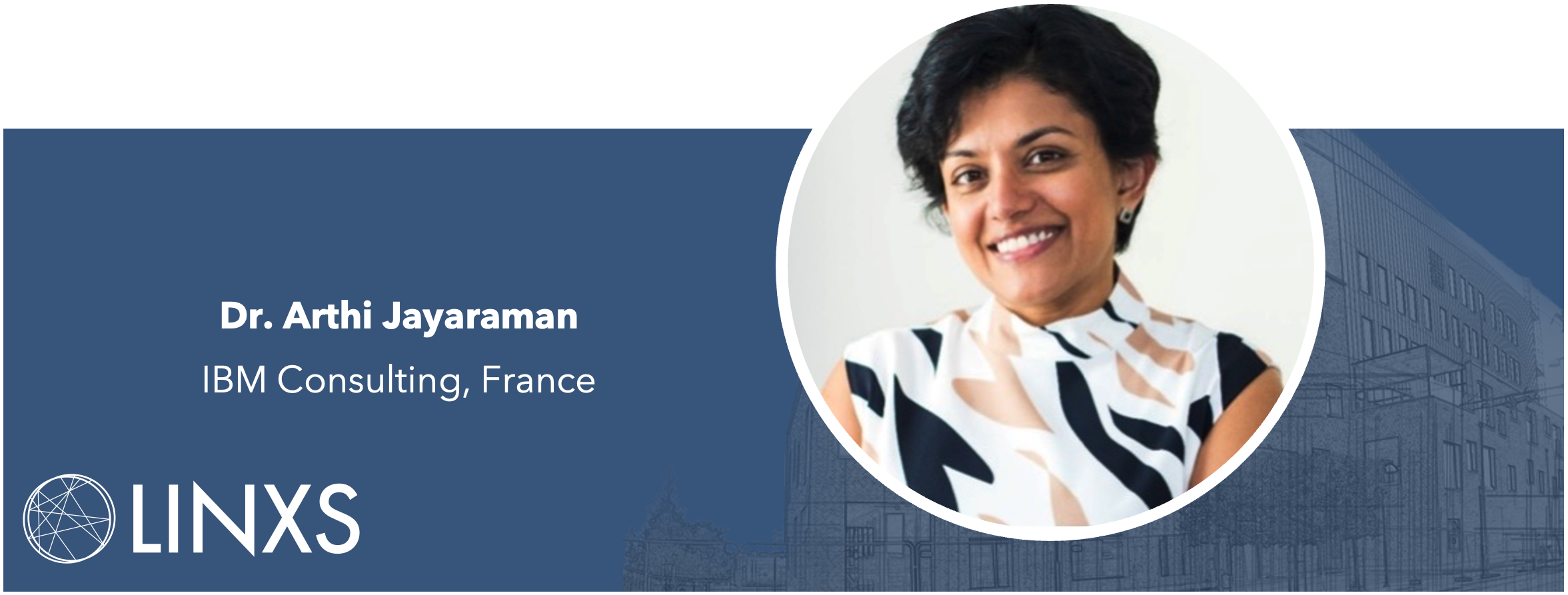
Speaker: Dr. Arthi Jayaraman, Chief Scientist AI for Materials, Science Next Team, IBM Consulting, France
Abstract
The multiscale structural characterization of soft materials—ranging from polymer solution assemblies to bio-derived soft gels and fibrils —is often bottlenecked by the difficulty of interpreting small-angle scattering (SAS) data. Traditional analysis typically relies on fitting analytical models to the SAS data, which often fail to capture the structural nuances of non-ideal, disordered, or multi-component systems. To address this, Jayaraman and her former lab at the University of Delaware pioneered the Computational Reverse Engineering Analysis for Scattering Experiments (CREASE) method and its extension, CREASE-2D.
CREASE is a machine-learning-integrated computational workflow that circumvents the limitations of traditional analytical model-based curve fitting. CREASE utilizes a genetic algorithm combined with machine learning surrogate model that links real-space structural features to scattering profiles to identify all possible real-space interpretations for a given I(q) vs. q or I(q, azimuthal angle) SAS profiles. CREASE-2D was developed specifically to handle anisotropic scattering patterns, enabling the characterization of oriented morphologies in processed (i.e., sheared) polymer systems. This talk will detail the evolution of CREASE and CREASE-2D, their application to complex polymer formulations, and how they bridge the gap between high-throughput characterization and automated fast analysis.
Biography
Dr. Arthi Jayaraman is an accomplished leader in computational materials science and chemical engineering, currently serving as the Chief Scientist for AI for Materials at IBM Consulting in France. Her career includes long-standing tenure at the University of Delaware as a Full Professor and the Centennial Term Professor for Excellence in Research and Teaching. Throughout her academic career, she has led the development and use of molecular modeling, simulations, and machine learning workflows, such as CREASE and RAPSIDY, to accelerate the discovery and characterization of complex soft materials. As of June 2026, Dr. Jayaraman has authored over 135 peer-reviewed publications and delivered more than 250 invited lectures globally. Her leadership extends to significant editorial roles, including serving as an Associate Editor for Macromolecules and the inaugural Deputy Editor of ACS Polymers Au. She is a Fellow of the American Physical Society, the American Chemical Society (PMSE), and the Royal Society of Chemistry and has received several honors including the IMPACT award from AIChE (American Insitute of Chemical Engineers) COMSEF Division, BITSAA Distinguished Alumna Award, and US-Department of Energy (DoE) Early Career Award. Furthermore, she has a proven track record of bridging the gap between academia and industry, having directed major NSF-funded initiatives and collaborated with global leaders such as Dow, DuPont, Merck, Chemours, IFF, Arkema, W.L. Gore and 3M. Her experiences seamlessly integrate polymer physics and chemistry with state-of-the-art computations making her a leading authority in the area of digital materials discovery and innovation.
Contact: Please contact mia.lindstrom@linxs.lu.se for practical questions
During our events we sometimes take photographs and short film clips to profile our activities. Please let us know if you don’t want to be in any photos/films before we start the event. Some webinars are recorded to be used for educational purposes in the LINXS website.
By registering to our events you give your permission to LINXS, according to the General Data Protection Regulation (GDPR), to register your name and e-mail address to be used for the sole purpose of distributing newsletters and communications on LINXS activities.