
When: 6 November, 10:00–11.00 CET
Where: LINXS, The Loop, Rydbergs torg 4, Lund, Sweden and online via Zoom
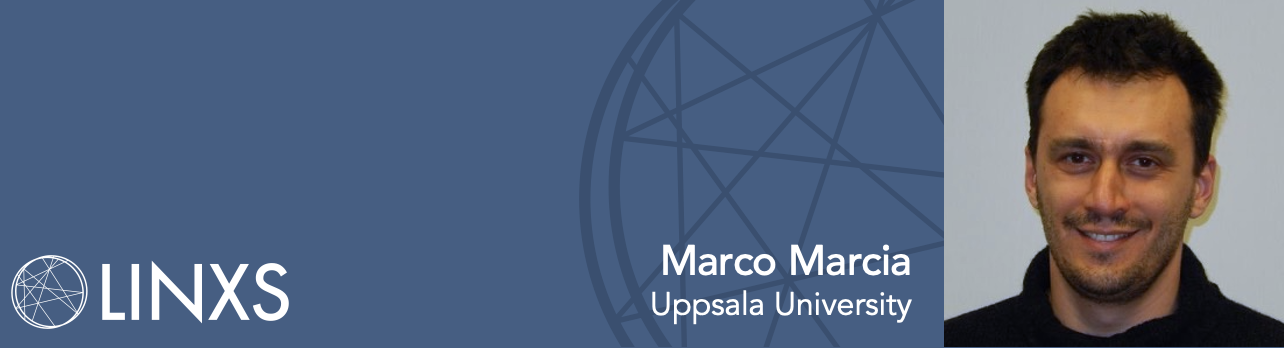
Speaker: Prof Marco Marcia, Department of Cell and Molecular Biology, Uppsala University, https://www.uu.se/en/department/cell-and-molecular-biology/research/structural-biology/marcia-lab
Title: Dissecting biological mechanisms and folding dynamics of medically-relevant large non-coding RNAs
Abstract
We are experiencing an “RNA revolution”. Genomes are pervasively transcribed into more non-coding RNAs (ncRNAs) than protein-coding RNAs. Moreover, new pharmacological opportunities are emerging to treat human diseases via modulation of ncRNA functions, either by targeting ncRNAs with small molecules or by using ncRNAs as drug vectors. But while we have a deep knowledge of protein structure, function, and dynamics and can accurately predict protein 3D structures from sequence using artificial intelligence, our mechanistic understanding of ncRNAs is still critically limited. My group contributes to fill this knowledge gap by applying RNA biochemistry, structural, cellular and molecular biology to the characterization of catalytic and regulatory bacterial and eukaryotic ncRNAs. In my talk, I will first show how we have elucidated the molecular mechanism of splicing through enzymatic, crystallographic and computational studies on a bacterial spliceosome ancestor, called the group II intron. I will then explain the implications of our group II intron work on understanding eukaryotic splicing and on developing gene-specific and RNA-directed drugs to treat cancer, congenital syndromes and infections. Finally, I will conclude by describing how our studies of splicing machineries enabled us to develop the experimental toolkit for pioneering the characterization of a newly-discovered class of regulatory ncRNAs, the so-called long non-coding RNAs. These latter molecules are key regulators of eukaryotic gene expression, and we have succeeded in dissecting the structure-functional complexity of prototypical lncRNAs through an interdisciplinary evolutionary, cellular, and structural approach, including by imaging them in 3D for the first time. In summary, our work connects the 3D structure and dynamics of large ncRNAs to their vital biological functions and opens still-unexplored research perspectives to understand ncRNA biology and to exploit the translational potential of ncRNAs in RNA-based therapies.
Biography
Marco Marcia is a Senior Lecturer/Associate Professor in Structural Biology at the Department of Cell and Molecular Biology, Uppsala University. He is also a visiting Group Leader at the European Molecular Biology Laboratory (EMBL) and an AIRC-funded visiting Group Leader at the Italian Institute of Technology (IIT), Genova.
Marco earned his PhD from the Max Planck Institute of Biophysics and Goethe University Frankfurt, followed by postdoctoral research at Yale University. He then spent a decade as a Group Leader at EMBL before joining Uppsala University in 2024.
His research uses integrated biochemical, biophysical, and cell biology approaches to study the molecular mechanisms of large non-coding RNAs and how they regulate gene expression, with a particular focus on RNA structure, RNA-targeted drug design, and splicing.
Contact: Please contact mia.lindstrom@linxs.lu.se for practical questions
During our events we sometimes take photographs and short film clips to profile our activities. Please let us know if you don’t want to be in any photos/films before we start the event. Some webinars are recorded to be used for educational purposes in the LINXS website.
By registering to our events you give your permission to LINXS, according to the General Data Protection Regulation (GDPR), to register your name and e-mail address to be used for the sole purpose of distributing newsletters and communications on LINXS activities.