
Registration will open February 2027
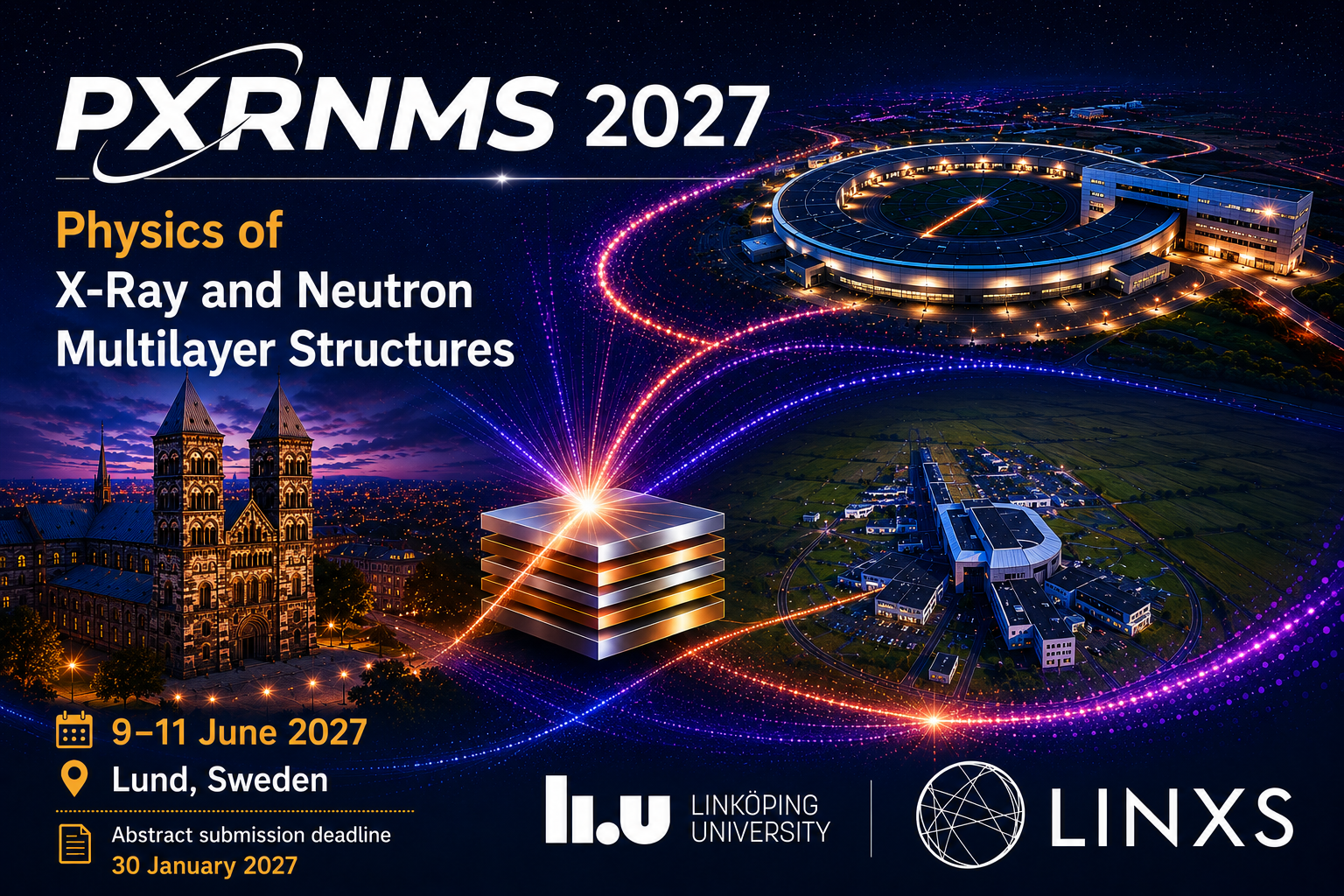
When: 9–11 June, 2027
Where: LINXS, workshop room on the 3rd floor (The Loop, Rydbergs torg 4, 224 84), Sweden
About
The Physics of X-Ray and Neutron Multilayer Structures (PXRNMS) conference series originated from the PXRMS meetings first held in 1992, focusing on multilayer optics and interface physics. After a pause, it was revived in 2016 and has since been held regularly across Europe and Asia, bringing together experts in thin films, X-ray, and neutron multilayers. The conference covers growth, characterization, and applications of nanoscale multilayer structures. For the first time, PXRNMS will be held in Scandinavia, organized by the Thin Film Physics Division at IFM, Linköping University. It will take place in Lund in June 2027, with visits to European Spallation Source and MAX IV Laboratory.
The conference welcomes participants from academia and research working in thin films, multilayer structures, and interface physics, as well as scientists and engineers involved in X-ray and neutron instrumentation. It is also of interest to professionals from industry, including the space and electronics sectors, and to users of large-scale research facilities such as synchrotrons and neutron sources.
Researchers and practitioners interested in both fundamental studies and applied aspects of multilayer systems are encouraged to participate.
PXRNMS 2027 will include a dedicated session honoring James Underwood, a pioneer in the field whose contributions have had a lasting impact. Dr. Eric Gullikson (Lawrence Berkeley National Laboratory) will contribute a talk in his memory.
The Workshop will focus on the physics of nanometer-scale multilayer films optimized for various applications in the Extreme Ultraviolet (EUV) and the X-ray domains, and in the Neutron optics. The main topics that will be discussed include:
• Multilayer X-Ray and Neutron Optics
• Film Growth and Microstructure
• Surface and Thin-Film Modifications using Ion Beams
• Growth Models and Computer Simulations
• Surface and Interface Topology
• Wavefront Characterization and Correction
• Optical Properties
• Polarization Control
• Bandpass Optimization
• Roughness and Interface Formation
• Film Removal Techniques
• X-Ray and Neutron Scattering
• Layer and Interface Composition
• Mechanical Properties and Stability
• Novel Characterization Techniques
• Metrology
For questions, please contact: Naureen Ghafoor, naureen.ghafoor@liu.se
During our events we sometimes take photographs and short film clips to profile our activities. Please let us know if you don’t want to be in any photos/films before we start the event. Some webinars are recorded to be used for educational purposes in the LINXS website.