
LINXS can play a role in disseminating the new possibilities afforded by ForMAX
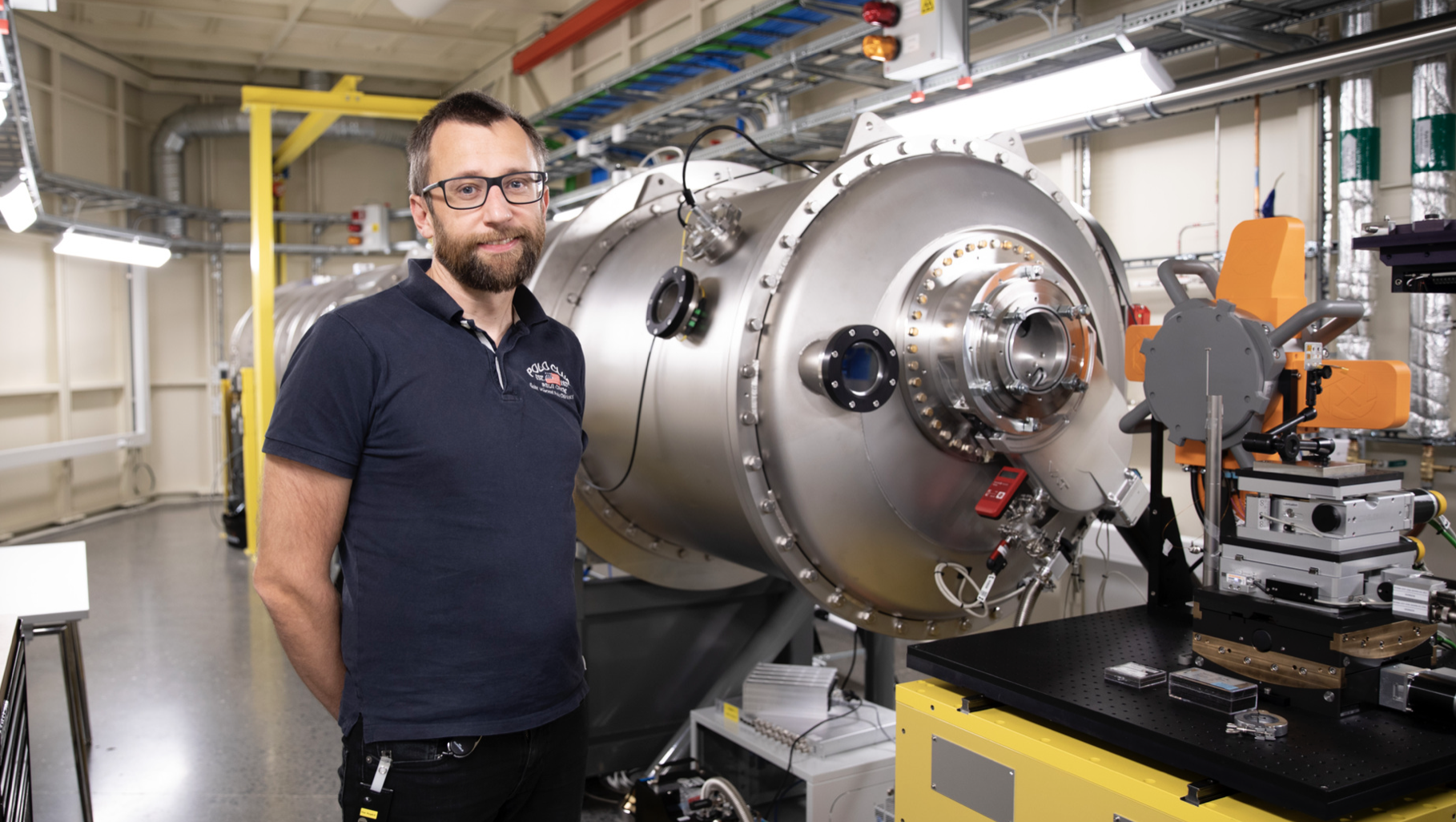
Kim Nygård is a researcher at MAX IV Laboratory, and beamline manager for ForMAX. He is pictured in front of ForMAX. Photo: Anna Sandahl.
In November, the ForMAX beamline at MAX IV officially opened for user experiments. The beamline is especially designed for advanced studies on wood-based materials, but can also be used for research on food, textiles and within life sciences. Beamline manager Kim Nygård, previous LINXS fellow under the Dynamics theme, can see many ways in which LINXS can support dissemination of the new possibilities afforded by ForMAX.
– From a technical point of view, ForMAX will provide some unique means for structural characterisation of materials, in particular multiscale, from nm to mm length. It can be used to study processes in situ, and is suited to investigate a range of fibrous materials, says Kim Nygård, researcher at MAX IV Laboratory and beamline manager for ForMAX.
LINXS can help disseminate possibilities afforded by ForMAX
While he expects a big demand for the new beamline, which just had its first user call, he believes that LINXS can play an important role in disseminating the new possibilities afforded by ForMAX to different user groups.
– At LINXS, many different researchers work in themes to progress science related to X-rays and neutrons. It is a good setting to highlight how ForMAX can support new science, especially related to food and life sciences. It can also be a place for discussion of how the X-ray experiments at ForMAX can be complemented with simulations and other techniques and tools.
User community existing of both academics and industry users
Kim Nygård is especially glad that the beamline is an initiative where several market-leading industry companies, mainly from the paper and pulp industry, and academia have joined forces.
– We now have a user community consisting of not just academics, but of industry users too. That really excites me. That means that we can work on different time scales in terms of impact. On the one hand we try to progress basic research questions, where we solve problems within a time frame of 15-20 years. On the other, we have the industrial perspective, where we are aiming to see applicable results in only two to three years.
– It is great that we can now address both needs with ForMAX, and I am very much looking forward to see what comes out of the experiments over time, he concludes.
About ForMAX
ForMAX allows in-situ multiscale structural characterization from nm to mm length scales by combining full-field tomographic imaging, small- and wide-angle x-ray scattering (SWAXS), and scanning SWAXS imaging in a single instrument. The beamline operates at 8-25 keV, with a beam size at the sample of ≈ 1μm – 5 mm depending on mode of operation.
ForMAX is funded by the Knut and Alice Wallenberg Foundation and Swedish industry via Treesearch – a national platform for research on new materials and speciality chemicals from forest raw material. The beamline is accessible for both Threesearch members and general users through the MAX IV user program.