
Giovanna Fragneto: “My ambition is for ESS to secure a prominent place for neutrons within the scientific landscape.”
“My ambition is for ESS to secure a prominent place for neutrons within the scientific landscape.”

To support the uptake of neutron techniques, Giovanna Fragneto emphasises the need for neutron facilities to collaborate around issues such as beamtime availability, software and sample environments.
The coming years will be busy for Science Director Giovanna Fragneto. As she and the rest of the team at the European Spallation Source (ESS) prepare to open for users at the beginning of 2028, her focus is on defining the first user experiments at ESS and creating a long-term science delivery plan. This involves making sure support services for users are in place, sample environments are validated, and that the required software is ready.
“It is exciting to be finally transitioning from a project phase to steady state operations. Especially as ESS will offer several unique neutron capabilities,“ says Giovanna Fragneto, Science Director at ESS.
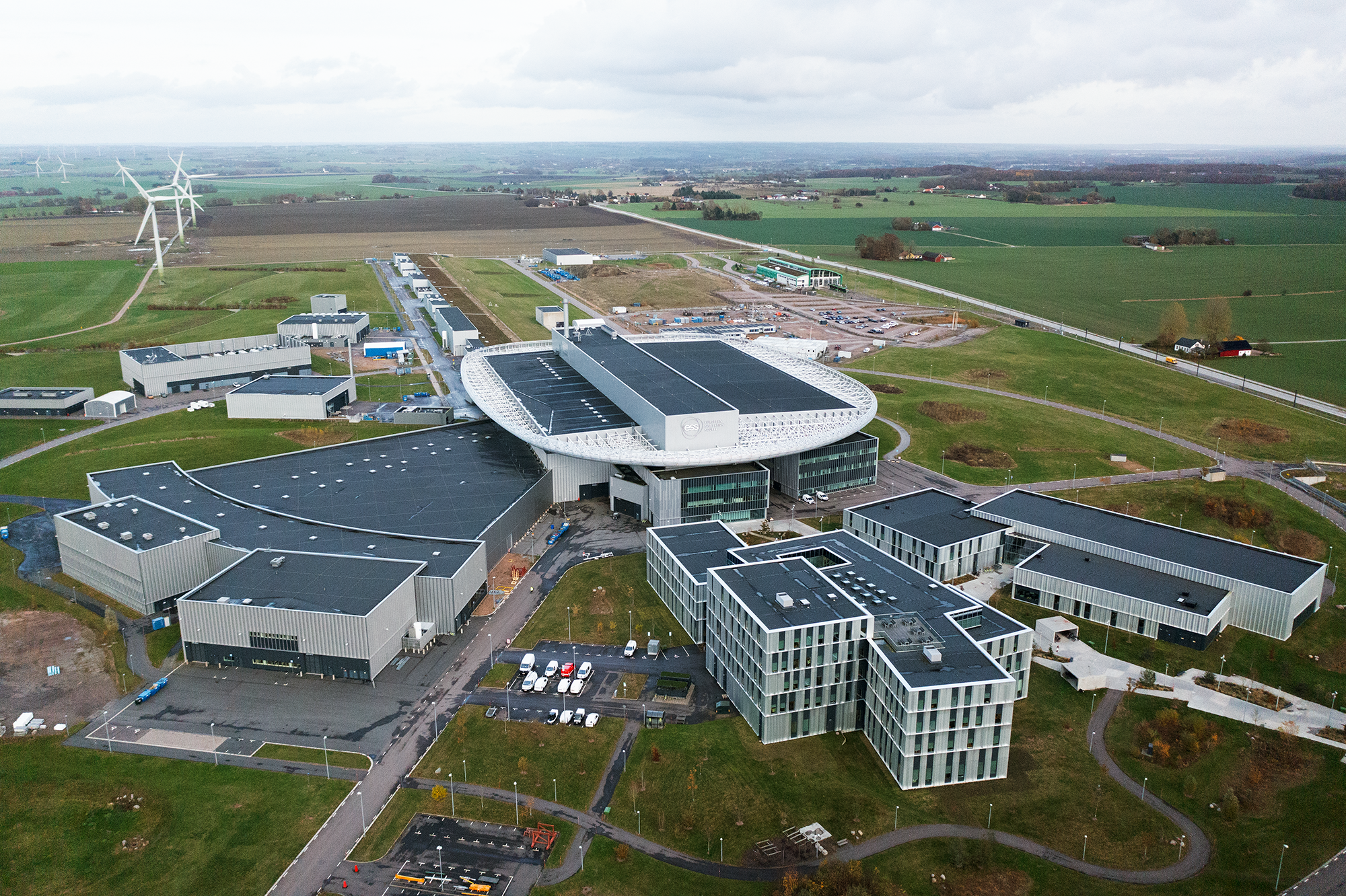
Fifteen scientific instruments are currently being installed at ESS, each with different capabilities. These include diffraction instruments, spectroscopy instruments, instruments for engineering and industrial samples, and instruments designed to study large-scale structures. The picture was taken in November 2025.
To define the first science experiments, ESS is currently engaging with neutron users in their 13 European member states. Together, they will develop and test capabilities and optimise sample environments. Initially, ESS will operate at a lower power, with fewer neutrons, sufficient to ensure that everything works as intended. After that, more challenging samples, that make use of faster and higher-intensity neutron measurements, will be tested.
Fifteen scientific instruments are currently being installed at ESS, each with different capabilities. These include diffraction instruments, spectroscopy instruments, instruments for engineering and industrial samples, and instruments designed to study large-scale structures.
ESS will enable faster measurements and capabilities to explore more challenging samples
Giovanna Fragneto hopes that ESS will enable more researchers to become neutron users, since up to now neutrons have struggled to become established in the research community. In contrast to X-ray techniques, neutron techniques cannot be used in university labs, nor are they commonly taught to students, which could be contributing factors.
“One of the big strengths with neutrons is that we will be able to study the behaviour of materials with non-destructive techniques. At ESS, we will be able to explore more challenging samples and perform faster measurements than ever before.”
For science, the potential is almost endless, as the limits of certain scientific questions can be pushed with new possibilities to study material structures. This opens up scientific opportunities in fields as diverse as quantum materials, heritage science, and life science.
“I am personally excited about how our instruments can further expand the recent explosion of in operando studies of batteries and hydrogen systems, as well as advance imaging and tomography measurements for a wide range of samples.”
Collaboration between neutron facilities can improve neutron experiments and grow the user community
To support the uptake of neutron techniques, Giovanna Fragneto emphasises the need for neutron facilities to collaborate around issues such as beamtime availability, software and sample environments. Worldwide, there are currently 25 - 30 active neutron facilities, offering complementary capabilities and sample environments.
“Users will not apply again after two or three failed attempts to get beamtime. It is very important that we have a good number of facilities operating in the world and that we have complementarity across instruments and environments.”
She adds:
“Everyone benefits from progress made elsewhere, and we need to exchange know-how to improve neutron experiments.”
One area where collaboration is especially important is around establishing laboratories which can deuterate samples, which is essential to perform many neutron scattering experiments. Deuteration is a labelling technique that replaces hydrogen atoms in molecules with a heavier isotope of hydrogen called deuterium and allows to enhance or remove the signal of specific parts of a molecule or more complex system.
“It is impossible for one single facility to develop a deuteration strategy for the wide variety of samples you find in a neutron facility, so here we can collaborate to support users.”
What does Giovanna Fragneto enjoy about working at ESS?
“It is exciting to build up the facilities and shape how the organisation will operate: to define the first science. At the moment, we are hiring many scientists to help us develop ESS. They will be at the forefront of running experiments and helping users.”
To her role she brings more than 25 years of experience of working with neutron-based research in different leadership roles at the neutron facility Institut Laue-Langevin (ILL) in France. As ESS is an international facility, policies for member countries’ beamtime access and applications will be required.
“I help to set a clear focus for how to operate an international facility. In contrast to most other neutron facilities, ESS has an important remit to serve all its thirteen member countries equally. This international focus needs to be part of the mindset of all staff.”
How should researchers interested in being part of the first experiments at ESS prepare?
“The most important thing is to follow the instrument development at ESS, engage in discussions with our scientific staff and and contribute to the activities that shape our collective scientific future,” says Giovanna Fragneto.
ESS has already organised many first science workshops with researchers from its member states. These are excellent opportunities to get involved early and to influence instrument development, Giovanna Fragneto emphasises.
“We encourage anyone interested in ESS to join! Building up a relationship with the user community is one of our main priorities in making ESS successful.”