
LINXS’ significance for developing a strong neutron community
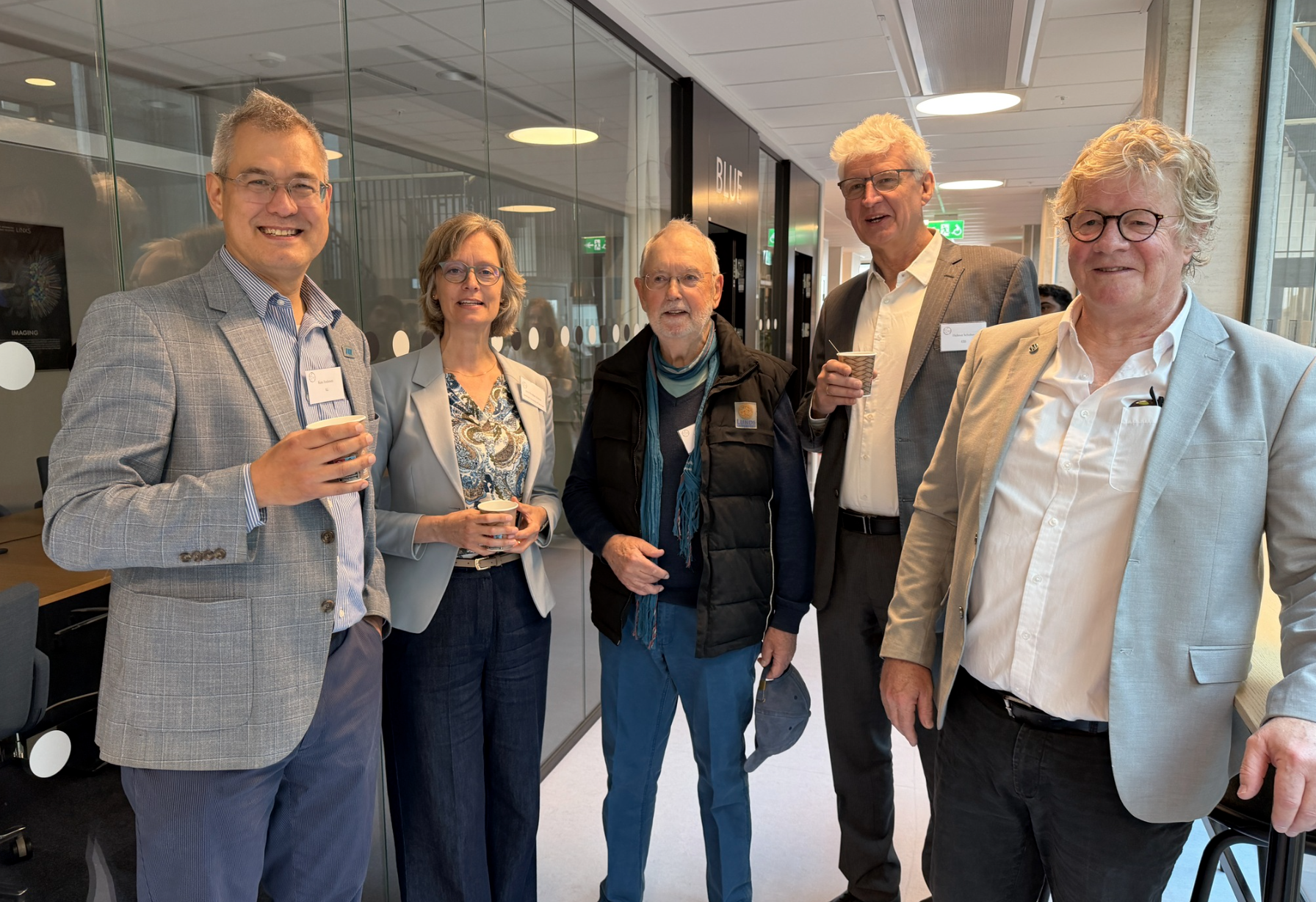
Leading figures for ILL, ESS and LINXS pictured at LINXS Science Day in June. From left to right: Ken Andersen, Director General of ILL, Jane Hvolbæk Nielsen, incoming Director General of ESS, Colin Carlisle, ESS first Director General, Helmut Schober, current Director General of ESS, and Trevor Forsyth, LINXS Director.
Ken Andersen, Director General at the Institut Laue-Langevin (ILL) in Grenoble, France, is excited about LINXS’ role in supporting a growing neutron community worldwide as ESS is set to open in early 2027.
He visited Lund, Sweden, for LINXS Science Day in June, where he delivered a keynote address.
"LINXS supports both X-ray and neutron users, which adds value to the co-location of MAX IV and ESS," says Ken Andersen. "In Grenoble, ILL and the X-ray facility ESRF are similarly co-located, and I think there is great potential for closer collaboration between our facilities."
"As far as I know, there is nothing like LINXS elsewhere, even though this kind of construct is really needed. Both neutron and X-ray facilities need to collaborate to highlight their different strengths and complementarities to the user communities."
"The most advanced research questions cannot be answered through one technique alone but rather require many experiments using different methods. Here, we can collaborate to support users in seamlessly accessing different large-scale facilities."
LINXS: connecting ILL and ESS
Ken Andersen underscores how LINXS can play an important role in bringing together the future users of ESS and user groups at ILL. He especially highlights the ongoing theme model at LINXS, where researchers can apply for funding to explore and develop a field of research using X-rays and/or neutrons over a three-year period. Through future themes, researchers can come together to advance neutron science.
At this year’s Science Day, attendees heard many presentations focusing on how X-rays have contributed to revealing new knowledge about everything from soft matter to heritage science. The same potential exists for neutrons, Ken Andersen notes, but the user community is currently smaller.
LINXS can support ESS in developing neutron science
Jane Hvolbæk Nielsen is the incoming Director General of ESS and will take over from the current Director General, Helmut Schober, on 1 November. In her previous role, she served as Denmark’s scientific delegate to the ESS Council.
During her attendance at LINXS Science Day, she reflected on her anticipation of getting to know ESS from the inside.
"It will be exciting to learn more about the neutron user community and the whole ecosystem around ESS over the next few months."
She agrees with Ken Andersen that LINXS can support the ESS user community.
"I think the LINXS initiative is really exciting. You are truly doing something important to build up the community and ensure that researchers are ready to carry out science at ESS when it goes into operation."
She also identifies LINXS’ themes as an important driver of neutron science.
"LINXS themes could be an inspiration for ESS: how can we support the new scientific questions posed by these groups? How do these questions align with our instrument suite?"
She continues:
"It will also be interesting to see which areas the LINXS community identifies as emerging fields and to hear from scientific groups that are either new to neutron science or not yet neutron users."
Huge potential for neutron science to address global challenges
Both Ken Andersen and Jane Hvolbæk Nielsen are continually impressed by the contribution neutron science makes to society.
"The breadth of applications and impact is enormous, from both scientific and technical perspectives. Neutrons can provide new knowledge for batteries, fuel cells, and solar cells. The fact that researchers can study real energy devices while they are operating, with the aim of improving their performance and sustainability, is truly unique," says Ken Andersen.
Jane Hvolbæk Nielsen adds that neutron science has significant potential to support various EU initiatives, especially in the areas of advanced materials for clean energy and sustainability.
"The upcoming EU Advanced Materials Act, which aims to accelerate the research, scale-up, and deployment of advanced materials and is expected in late 2026, will present an important opportunity. Neutron science can make a huge contribution by supporting the widespread use of advanced materials across different sectors of society."