
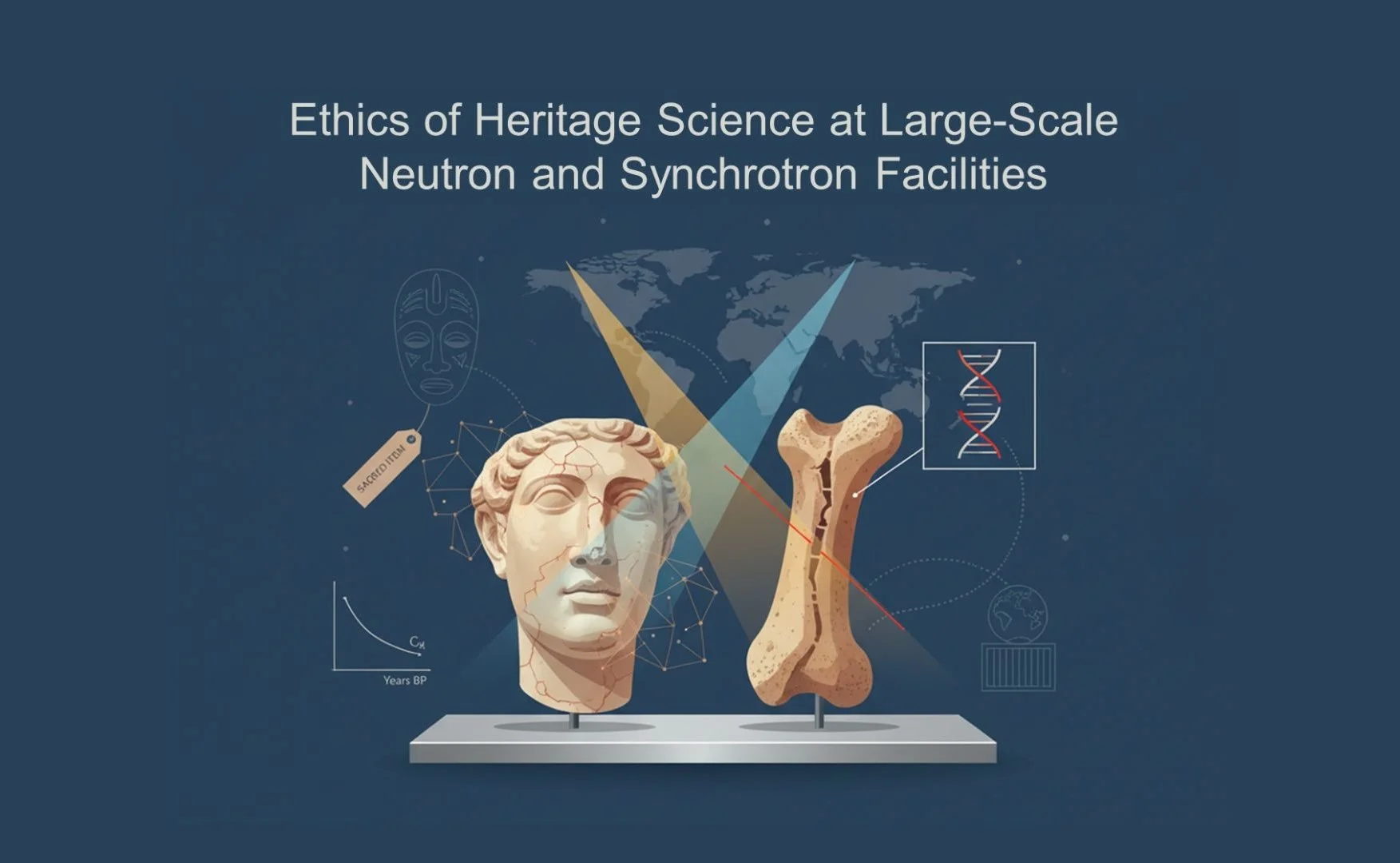
What are the ethical implications of heritage science work with synchrotrons and neutrons? What new ethical questions need to be addressed as these new methods are increasingly applied to cultural and natural heritage research? Come debate these questions with an interdisciplinary group of international specialists!
When: 20-21 May, 2026
Where: LINXS, The Loop, Rydbergs torg 4, 224 84 Lund
Organisers: LINXS Heritage Science Theme, all working groups
Target Group: Heritage Scientists, Anthropologists, Archaeologists, Museum Specialists, Beamline Scientists
ABOUT
The increasing access of heritage researchers to large-scale facilities coupled with the highly significant nature of the artefacts sent for analysis makes it especially important to consider the ethics involved in investigating items using neutron and synchrotron techniques. Often these approaches are described as “non-destructive” when discussing analysis with museums and other stakeholders. But what does this really mean? Do synchrotron- and neutron-based techniques alter the physical nature of artefacts? Are there other types of culturally sensitive impacts we should consider (e.g. when working with indigenous communities or part of collections acquired during colonial times)? Are such alterations significant (and if so, to whom)? And what considerations need to be taken for the transport, handling, and return of culturally significant heritage items?
As large-scale facilities are increasingly incorporated into the workflow of heritage research projects, it is important that we take a step back in order to consider the ethical implications of our scientific practice. This workshop will include a range of heritage science specialists from both large-scale facilities as well as museums in order to consider the ethics of heritage science using synchrotrons and neutrons.
-
DAY ONE
Introduction
09:00–09:15 Coffee and welcome
09:15–09:20 Prof. Augusto Marcelli, Scientific Attaché at the Italian Embassy in Sweden
09:20–09:30 LINXS Introduction: Mikael Fauvelle, Lund University - “LINXS and the Heritage Science theme”
Session 1 – Scientific Ethics in a Museum context
09:30–09:55 Setting the Stage: What is heritage ethics and why should we care about it? - Jamie Hampson, University of Exeter.
09:55–10:20 Reframing Non-Destructive Analysis: Possible Ethical Tensions from a Museum Perspective - Björn Nilsson, University Museum of Bergen
10:20–10:50 Coffee Break
10:50–11:15 Balancing Scientific Research and Responsibility: Ethical Considerations in the Analysis, Sampling and Display of Museum Collections - Lucia Burgio, Victoria and Albert Museum.
11:15–11:40 Working with Neutrons in Cultural Heritage Is it worth it? Are we ready? - Laura Perucchetti, The British Museum.
11:40–14:00 Poster session & Lunch (simultaneously)
Session 2 – Is it really non-destructive?
14:00–14:25 Ionizing Radiation Imaging of Archaeological Biogenic Materials: Implications for Museomics - Laura Longo, Ca' Foscari University of Venice
14:25–14:50 The Duality of X-ray Methods in Heritage Research - Susan Nehzati, Diamond Light Source.
14:50–15:15 Neutron Techniques for Cultural & Natural Heritage, Illuminating the Past and Navigating Hidden Risks - Anna Fedrigo, Institut Laue Langevin (ILL).
15:15–15:45 Coffee Break
15:45–17:15 Roundtable Discussion, open to all participants. Led by Courtney Nimura, Ashmolean Museum, and Lucia Mancini, ZAG.
19:00–21:00 Social dinner (only for organizers and speakers)
-
DAY TWO
Session 3 – Digital Heritage and Shared Knowledge
9:00–09:25 Ethics in palaeontological research - Imran Rahman, Natural History Museum.
09:25–09:50 Synchrotron X-ray CT in Natural and Cultural Heritage - Vincent Fernandez, The European Synchrotron (ESRF).
09:50–10:15 Visualizing tomographic datasets by means of VR, AR and CAVE -Emanuel Larsson, Lund University.
10:15–10:45 Coffee Break
Session 4 – What are Sensitive samples
10:45–11:10 Patrick Randolph Quinney, Uppsala University.
11:10–11:35 Ethics in Heritage Science: the Bioanthropological Perspective - Luca Bondioli, University of Padua.
11:35–12:00 Open Q&A session
12:00–13:30 Lunch
13:30 Roundtable Discussion, Led by Organizing Committee.
-
Mikael Fauvelle (main organiser)
Susan Nehzati
Courtney Nimura
Anna Fedrigo
Lucia Mancini
Björn Nilsson -
▸ Ethics in Heritage Science: the Bioanthropological Perspective
Luca Bondioli, Institute of Geological Sciences, Polish Academy of Sciences, Kraków Research Centre, Kraków, Poland
Alessia Nava, Department of Odontostomatological and Maxillofacial Sciences, Sapienza University of Rome, Rome, Italy
Ethics in bioanthropology are of the utmost importance. The study of human skeletal and dental remains has profound implications, both in terms of their nature as the remains of our own genus Homo and because of their, often conspicuous, conservation issues. Human biological remains possess unique characteristics that distinguish them from other categories of archaeological, or more generally, museum artefacts. Skeletal remains are not merchantable and must not have a commercial value. They testify to our individual or group ancestry, but they also witness the natural history of our genus and are therefore part of humanity’s heritage. Furthermore, bioanthropological remains not only convey information and elicit emotions, but are also repositories of valuable information for understanding our history and the infinite facets of our human identity. Particularly for anatomical modern Homo, an assemblage of remains from multiple individuals is more informative than the simple sum of the information derived from the single specimen’s.
In practice, the study and analyses of human remains are governed by specific regulations in numerous countries, the application of which is not always straightforward. A practical approach would be to establish a framework based on a few key principles: respect for the remains; dialogue with and respect for the communities of descent; an objective assessment of the balance between analytical damage and information extraction; respect for stakeholders; and the dissemination of information to the broader public. In this context, synchrotron and neutron analytical techniques play an important and often critical role thanks to their minimal impact coupled with high resolution analytical power. This paper aims to provide examples of such techniques, highlighting their pros and cons and situating them within the broader framework of the study of the natural history of Homo.
▸ Synchrotron X-ray CT in Natural and Cultural Heritage
Vincent Fernandez, ESRF – The European Synchrotron, 71 avenue des martyrs, 38000, Grenoble, France
X-ray micro-Computed Tomography (micro-CT) has become a key imaging tool used in many areas of science. Prominently used in biomedical imaging, its application has broadened significantly over the years, including in the field of natural and cultural heritage. These latter applications pose distinct challenges: specimens can differ widely in size, geometry, and composition, and are often too valuable or fragile to be altered for easier scanning.
Nevertheless, micro-CT has proven extremely powerful in these contexts, enabling important discoveries and offering new insights into museum collections. Synchrotron facilities are frequently used to investigate fossils and artworks notably due to the X-ray beam high intensity, collimation, and spatial coherence. Such characteristics make synchrotron-based systems the benchmark for advanced X-ray tomography.
The increasing role of natural sciences and cultural heritage research is also influencing the evolution of synchrotron infrastructure. At the European Synchrotron Radiation Facility, for example, the BM18 beamline is being developed to accommodate the specific constraints and needs of these research areas, reflecting their growing prominence in the scientific community.
▸ Ionizing Radiation Imaging of Archaeological Biogenic Materials: Implications for Museomics
Longo L., D. Coppola, E. Badetti, D. Dreossi, E. Cilli, D. Luiselli, A. Scherillo, G. Marcucci
There has been a growing use of imaging techniques based on elementary particles for the investigation of archaeological artefacts. The most widely used methods rely on X-ray imaging, which has already demonstrated its ability to reveal invaluable information about the internal structure of artefacts. X-ray Computed Tomography (XCT) is generally considered a non-destructive technique suitable for archaeology and palaeontology, and it is widely applied in Cultural Heritage diagnostics, including synchrotron tomography [1, 2]. The ionizing nature of X-rays raises concerns about potential molecular damage, particularly to fragile ancient DNA (aDNA) and proteins, which are often preserved only in trace amounts. Despite their widespread use, few systematic studies have quantified the thresholds at which such damage occurs or assessed the impact on downstream analyses [3]. In an experiment carried out on archaeological skeletons, Fehren-Schmitz et al. (2016) [4] demonstrated that dehydrated archaeological human bone exposed to standard radiographic imaging techniques—a staple of bioarchaeological analyses—does not directly hinder the collection and amplification of DNA.
Biogenic samples from a Gravettian burial (>27 kyr BP) recovered from the cave of Santa Maria di Agnano (Ostuni, Brindisi, Italy), namely foot bones and shells from the ornaments accompanying the burial, underwent XCT and neutron scanning both before and after ancient DNA processing. Preliminary results will be presented and discussed from the perspective of the ethical implications of this scientific practice, particularly with regard to potential induced damage to ancient biomolecules and its impact on genomic and proteomic recovery. While our study supports the continued integration of radiographic and genetic analyses, multiple factors—including chronology, anatomy, environmental conditions, and taphonomic variables—must be considered when planning molecular analyses, whether before or after exposure to ionizing techniques.
1- Amendola, M et al. 2025. Exploring How Micro-Computed Tomography Imaging Technology Impacts the Preservation of Paleontological Heritage. Heritage 2025, 8, 310. https://doi.org/10.3390/heritage8080310
2- Nava, A., Coppa, A., Coppola, D. et al. Virtual histological assessment of the prenatal life history and age at death of the Upper Paleolithic fetus from Ostuni (Italy). Sci Rep7, 9427 (2017). https://doi.org/10.1038/s41598-017-09773-2
3- Reisz J. A. et al. 2014. Effects of Ionizing Radiation on Biological Molecules—Mechanisms of Damage and Emerging Methods of Detection. DOI: 10.1089/ars.2013.5489
4- Fehren-Schmitz L. et al. 2016. An investigation into the effects of X-ray on the recovery of ancient DNA from skeletal remains. http://dx.doi.org/10.1016/j.jas.2016.10.005
▸ Ethics in palaeontological research
Imran Rahman, Natural History Museum, UK
Imaging and analysis of fossils using synchrotron- and neutron-based techniques has provided invaluable insights into the history of life on Earth. With the growing interest in applying these techniques in palaeontological research, it is increasingly important to be aware of the potential ethical questions that could arise from such work. A particular area of concern is Myanmar amber, which preserves remarkable fossils that have shed new light on the diversity of past life, but is associated with serious legal and ethical issues. Fossils housed in private collections are another source of concern as these may not be accessible to other scientists for further study. Palaeontologists and specialists from large-scale facilities must work together to ensure all the specimens used in experiments were collected and exported ethically and in accordance with the relevant laws and that they have been deposited in a recognized, publicly accessible repository (e.g. natural history museum).
The event is co-sponsored by the Italian Embassy of Sweden.
Italian Cultural Heritage is recognized worldwide. The Embassy of Italy in Sweden is proud to support this international event hosted in Lund, where Italian scientists significantly contribute to the advancement of cultural heritage science

Contact
For practical questions, please contact mia.lindstroml@linxs.lu.se
The event is free of charge, but please note that we have a no-show fee of 200 SEK to offset the cost of ordered food.
During our events we sometimes take photographs and short film clips to profile our activities. Please let us know if you don’t want to be in any photos/films before we start the event. Some webinars are recorded to be used for educational purposes in the LINXS website.
By registering for our events you give your permission to LINXS, according to the General Data Protection Regulation (GDPR), to: (1) send you newsletters and information about LINXS activities, and (2) share your contact details (name and email address) with the event organizers for event-related communications. You can withdraw your consent at any time by contacting josefin.martell@linxs.lu.se or unsubscribing from our emails.
If you don’t receive a registration confirmation please check your spam mail.If you don’t receive a registration confirmation please check your spam mail.