
When: June 15, 14:00-15:00
Where: LINXS, workshop room on the 3rd floor (The Loop, Rydbergs torg 4, 224 84), with digital participation possibility via Zoom.
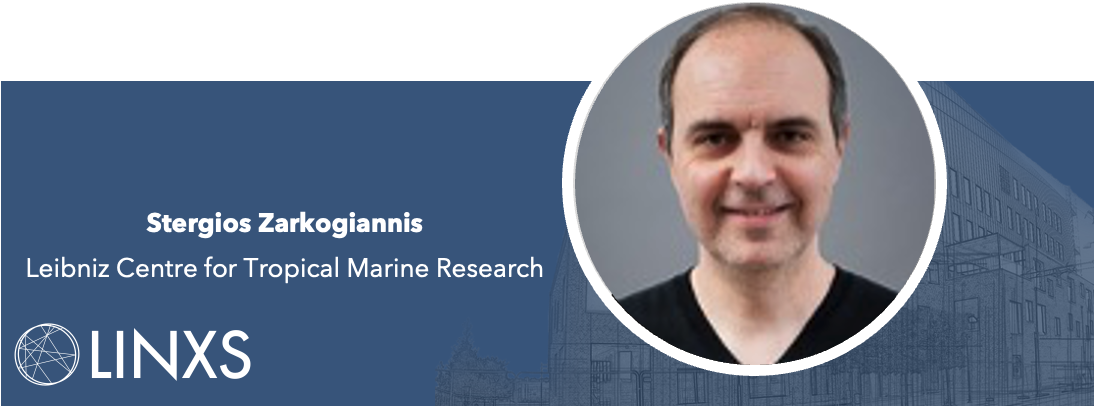
Speaker: Stergios Zarkogiannis, Leibniz Centre for Tropical Marine Research
Abstract: Planktonic foraminifera are single-celled marine organisms that build calcite shells and have done so since the Jurassic (~200 Ma). Their shells preserve a rich archive of past ocean conditions through geochemical proxies (δ¹⁸O, Mg/Ca, δ¹¹B), yet their potential to record past ocean physics remains largely unexplored.
I will show that foraminifera actively regulate their calcification according to ambient seawater density, as a depth-stabilising mechanism in response to physical changes in the water column driven by temperature and salinity. Using X-ray micro-tomography (μCT) to measure shell volumes combined with independent geochemical temperature and salinity reconstructions, I established a quantitative relationship between shell mass and ambient seawater density. This opens the door to reconstructing past ocean density and, by extension, surface ocean physics and current velocity directly from sediment cores.
I will also discuss how this plankton shell mass–seawater density relationship may have regulated atmospheric CO2concentrations and driven the global carbon cycle on both glacial–interglacial and longer timescales. The talk concludes with an outlook on ongoing work using μCT and these biomineral proxies that could particularly benefit from synchrotron X-ray imaging, as well as prospects for neutron-based boron analysis enabling non-destructive paleo-ocean pH reconstructions from museum collections.
Bio: Stergios Zarkogiannis is an oceanographer specialising in planktonic foraminifera and their role as recorders of past ocean conditions. He holds a PhD in Paleoceanography from the National and Kapodistrian University of Athens and an MSc in Environmental Coastal Engineering from the University of Southampton. His research career has taken him across leading institutions, including the Godwin Laboratory for Paleoclimate Research at Cambridge, the ICTA at Universitat Autònoma de Barcelona, and the Department of Earth Sciences at Oxford, where he held a Royal Society Newton International Fellowship followed by a Marie Skłodowska-Curie Fellowship. He is currently an Alexander von Humboldt Fellow at the Leibniz Centre for Tropical Marine Research in Bremen. His work bridges physical oceanography, palaeoclimate, and the carbon cycle, with a focus on biomineral proxies and advanced imaging techniques.
Contact: Please contact mia.lindstrom@linxs.lu.se for practical questions
During our events we sometimes take photographs and short film clips to profile our activities. Please let us know if you don’t want to be in any photos/films before we start the event. Some webinars are recorded to be used for educational purposes in the LINXS website.
By registering to our events you give your permission to LINXS, according to the General Data Protection Regulation (GDPR), to register your name and e-mail address to be used for the sole purpose of distributing newsletters and communications on LINXS activities.