
Helping researchers turn tomography data into science faster
Huge data sets, low image contrasts, and ‘noisy’ data – data analysis remains the key bottleneck for many researchers who perform X-ray and neutron experiments. A recent training and hackathon event at LINXS introduced three open-source analysis tools for analysing tomographic data and provided hands-on support to researchers who brought their own datasets.
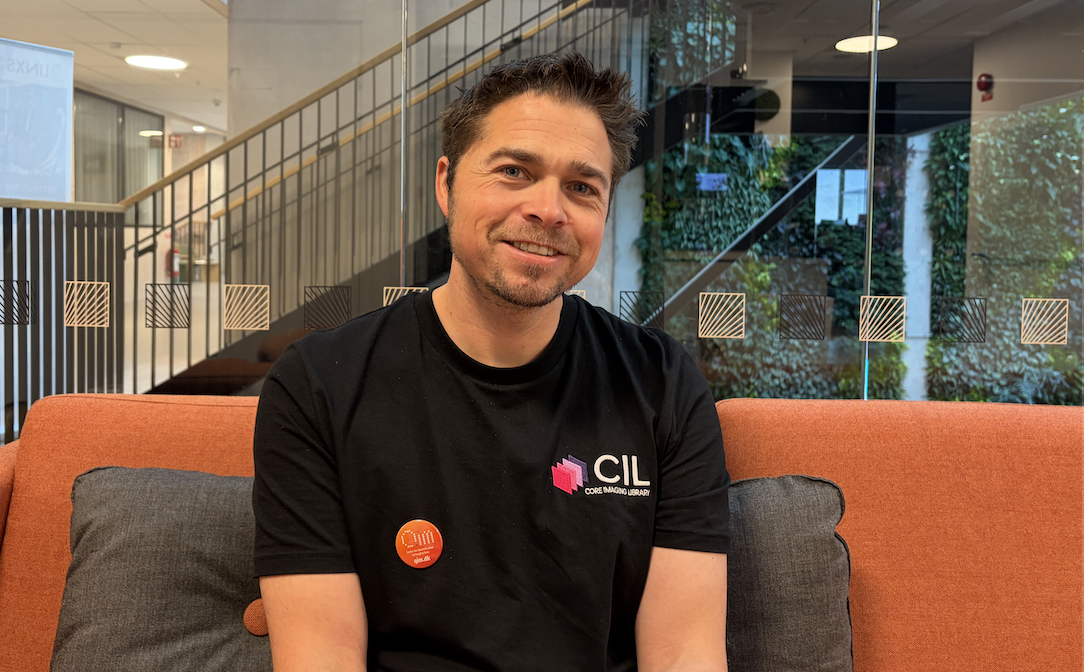
Jakob Sauer Jørgensen is Scientific Director of the QIM Center for Quantification of Imaging Data from MAX IV. He was very happy with the outcome of the event.
“We often say it takes a day to acquire the data, but a year to analyse it. We want to change this and speed up the time it takes to produce published science,” says Jakob Sauer Jørgensen, Scientific Director of the QIM Center for Quantification of Imaging Data from MAX IV, who organised the event in collaboration with the AIDA theme.
Attended by close to 40 participants from different scientific fields, the event ran across three days and introduced three established open-source software tools for analysing tomographic data: gVirtualXray (gVXR), an imaging library for X-ray simulations; the reconstruction tool Core Imaging Library (CIL); and qim3d, an image analysis tool for data segmentation and quantification.
“CIL is a useful library to reconstruct raw data from a variety of different CT instruments into the final 3D volumes you need for further processing. It can help you get rid of noisy or incomplete data, or data misalignment,” says Jakob Sauer Jørgensen.
“Qim3d, in turn, makes it possible to extract important quantitative information, for example the size of pores or holes in biomedical data. It can segment data and quantify what you are looking at.”
Developing image analysis at the centre of QIM’s work
Jakob Sauer Jørgensen started his role at QIM earlier this year. Working with X-ray and neutron users to develop image analysis is something he is passionate about.
“By providing open-source and user-friendly tools, we help people extract relevant data from their experiments. It is really about enabling science and supporting researchers to analyse data in ways they were not able to before.”
During the last few months, staff from QIM has started to accompany users during X-ray experiments at MAX IV. By being present when the users set up and run the experiment, they can get a better understanding of their analysis needs afterwards.
“To develop useful analysis tools that remain relevant, we need constant input from users regarding how they set up their samples and experimental parameters.”
In the future, Jakob Sauer Jørgensen believes that tools for analysing very large data sets will become indispensable. It is not unusual to see data sets that are many terabytes in size. QIM is currently developing new open-source tools that will allow users to work with data formats where one can zoom in on selected regions of interest .
“Data sets are becoming so large that they are unwieldy to work with. Our tools can be compared to Google Maps, where you zoom in on a house or a street to view it in greater resolution, without losing the overview.”
Being able to hold the event at LINXS was very valuable, he says.
“It is an amazing place, and spot-on for bringing experts, users and instrument scientists together!”
Preparing for X-rays before going large-scale
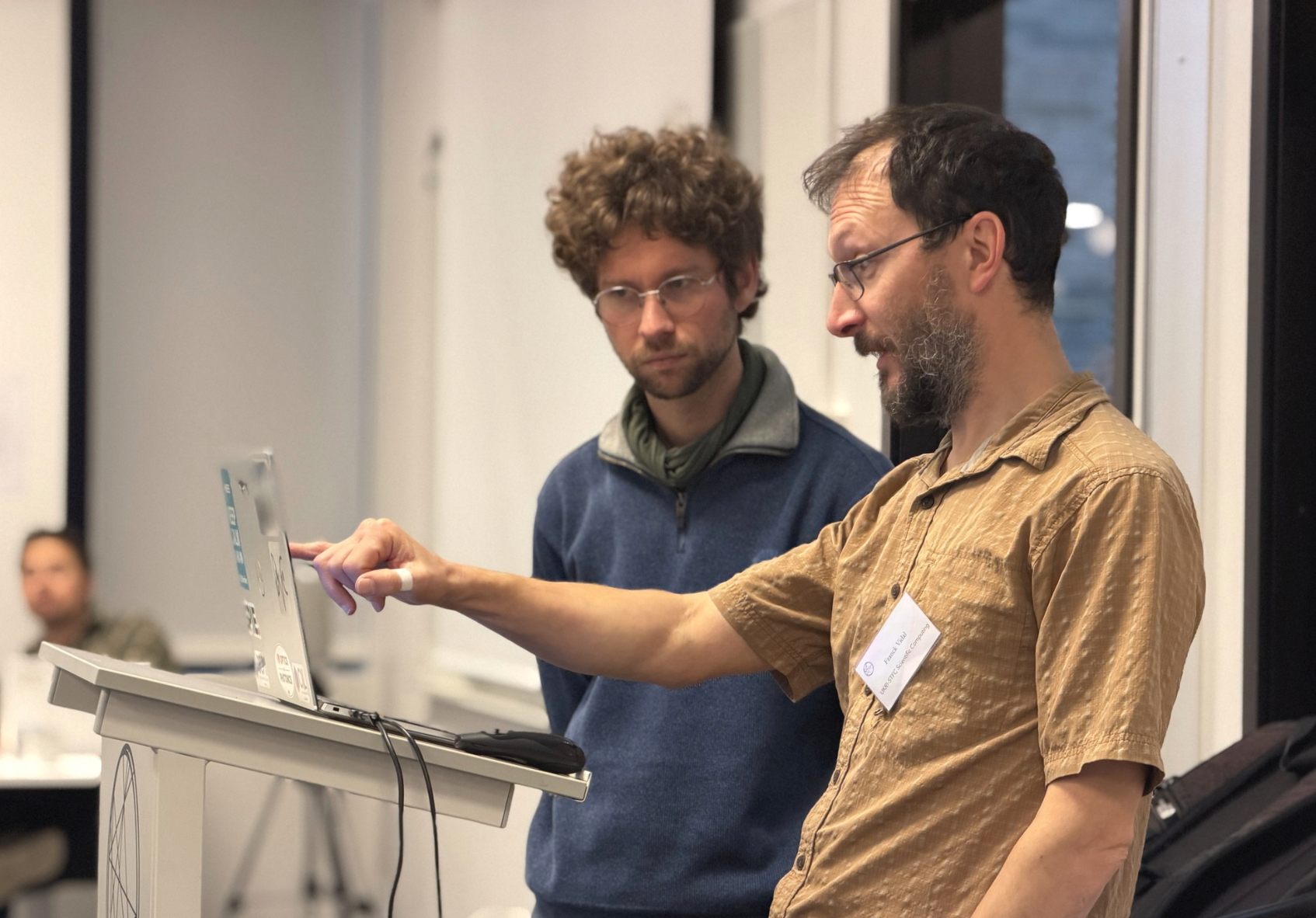
Franck Vidal pictured (at the front) talking to a participant during the AIDA training workshop.
Another instructor at the event was Franck Vidal, Computational Scientist in Imaging at Daresbury Laboratory in the UK. He was the person who originally developed the virtual X-ray imaging library, gVXR (‘g’ is for GPU), more than 20 years ago – mainly for his own scientific use. Over time, more researchers have started to use the tool to simulate images of the real sample ahead of large-scale experiments.
“Many experiments never lead to publications. Either they run into unexpected problems at the beamline, or the users are not able to analyse the data. With our tool, users can simulate the experiment beforehand to get an idea of how the sample will behave.”
Franck Vidal would like most beamtime applications to include a report with simulations of a representative sample to show proof that the experiment can be performed as planned, and that it can generate the expected data.
“Time is money, and our tool can save a lot of valuable time, ensuring that both individual users and facilities are better prepared, more efficient and ready to make the most of every opportunity.”
His hope is that the tool will contribute to lowering the entry barrier to facilities such as MAX IV and ESRF. In addition to pre-simulation, it can also support users in analysing their data afterwards. It is indeed predicted that most AI-models will be trained with simulated data in the future; and many users of gVXR are doing this already.
“Ideally, this tool could become integrated into the standard packages that are offered at the facilities today. It would make a big difference for the rate of successful and relevant experiments, I believe.”
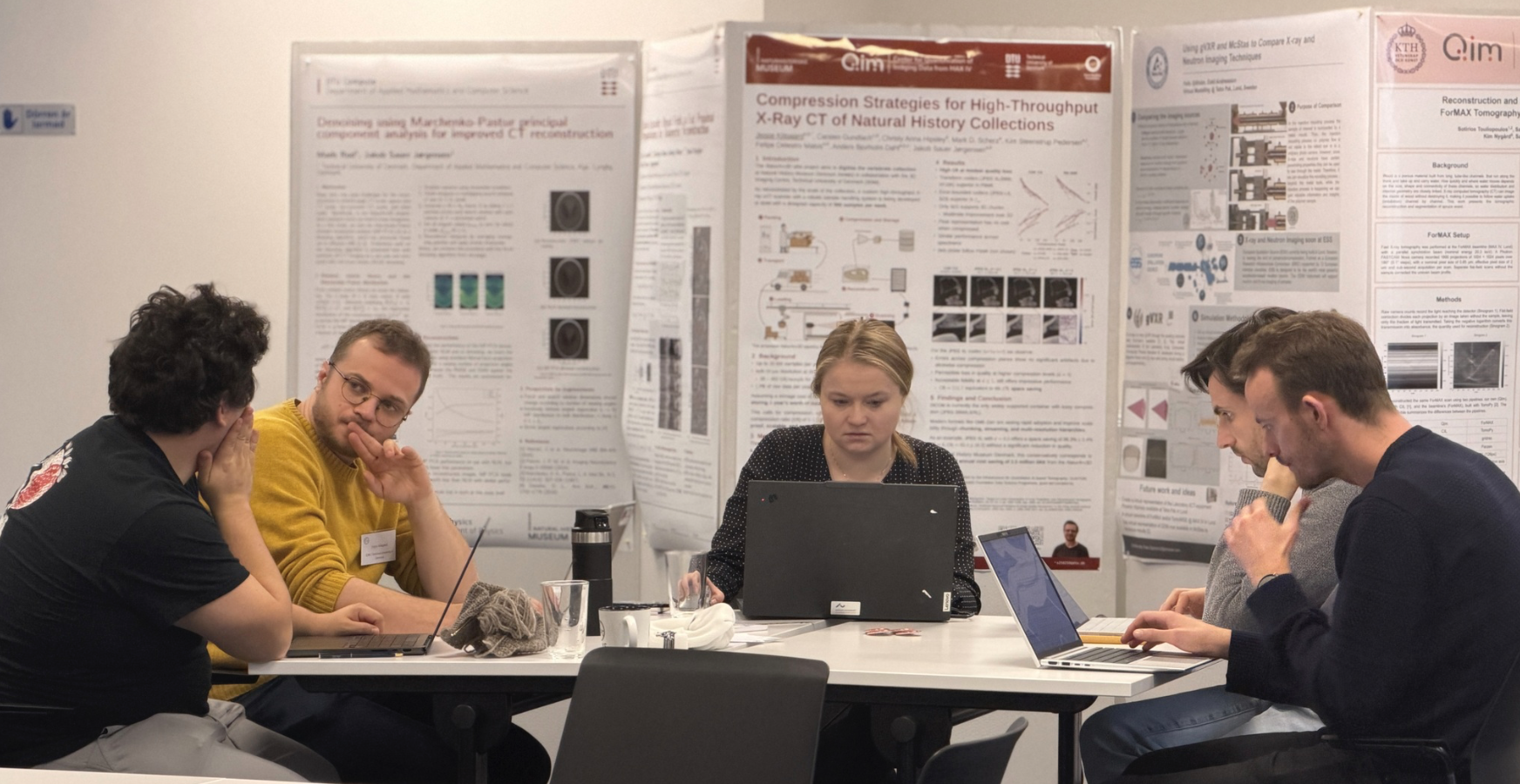
Participants working with their data during the AIDA workshop at LINXS. Instructors and trainers for the different software tools were on hand to provide hands-on support.