
Welcome Stergios Zarkogiannis, new guest researcher with the Environment and Climate theme
LINXS warmly welcomes Stergios Zarkogiannis, new guest researcher with the Environment and Climate theme. He is an Alexander von Humboldt Experienced Research Fellow at the Leibniz Centre for Tropical Marine Research (ZMT) in Germany.
He is staying at LINXS from mid-May to mid-June.
What are your research interests and your background?
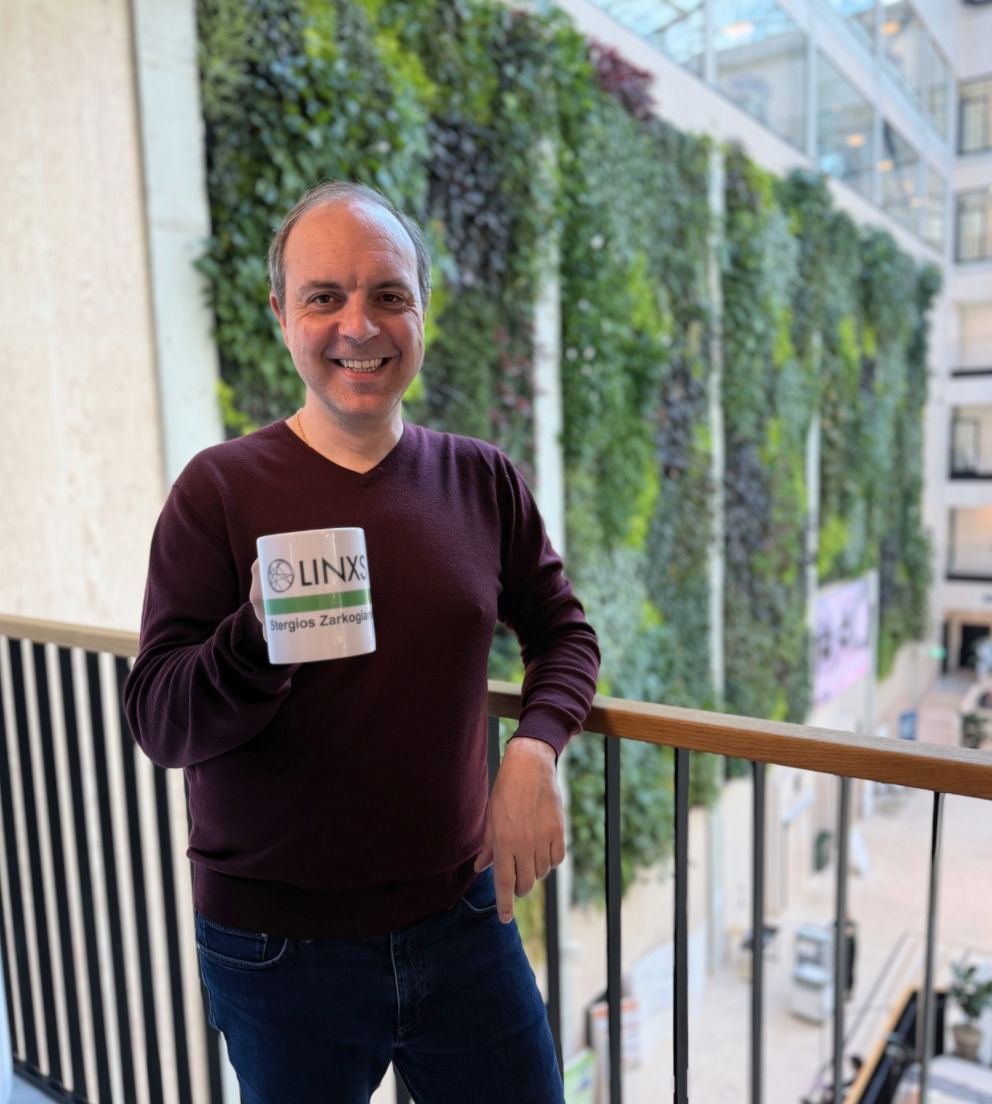
Stergios Zarkogiannis is pictured with the customary LINXS mug, which is gifted to all LINXS guest researchers.
I am a (palae)oceanographer interested in the biomineralisation of marine calcifying plankton, particularly planktonic foraminifera and coccolithophores, and their role as recorders of past ocean conditions.
My work bridges physical oceanography, palaeoclimate and the carbon cycle, with a focus on biogeochemical proxies and advanced X-ray imaging techniques. I hold a PhD from the National and Kapodistrian University of Athens and have held fellowships at the University of Oxford (Royal Society Newton and Marie Skłodowska-Curie) and am currently an Alexander von Humboldt Fellow at the Leibniz Centre for Tropical Marine Research in Bremen.
My key contribution so far has been establishing that planktonic foraminifera regulate their calcification according to ambient seawater density, a discovery with direct implications for how we reconstruct past ocean physics and carbon cycling from deep sea sediment cores.
What will you work on during your stay in Lund, Sweden?
I will be using synchrotron and laboratory X-ray microtomography to characterise the three-dimensional shell architecture of planktonic foraminifera from modern Red Sea sediments at unprecedented resolution, with the aim of extracting proxies that record past changes in seawater physics such as density (i.e. temperature and salinity).
I am also interested in exploring the potential of neutron-based techniques for non-destructive boron analysis of foraminiferal shells, which would open new possibilities for paleo-ocean pH reconstructions using museum collections.
Why did you choose to come to LINXS?
LINXS sits at the heart of a unique concentration of large-scale research infrastructures, and the combination of synchrotron and neutron capabilities in one place is unmatched. The Environment and Climate theme at LINXS is a natural fit for my research, and the opportunity to connect with scientists applying these techniques across disciplines is precisely the kind of cross-pollination my work can benefit from.
What do you hope you'll get out of the visit overall?
I hope to establish new methodological workflows combining X-ray and neutron techniques for the study of microfossils, and to build lasting collaborations with researchers at LINXS and the surrounding institutions.
There is much to gain from techniques that have long been standard in materials science, physics and engineering but remain underutilised in marine sciences, and this visit is an opportunity to bridge that gap and bring these tools into the palaeoceanographic toolkit.
More broadly, I hope the visit will help open a new chapter in how we use biomineral archives to reconstruct past ocean physics, going beyond conventional geochemistry.
Read more about Stergios Zarkogiannis at the Leibniz Centre for Tropical Marine Research (ZMT)