
LINXS portrait: Annika Stellhorn, instrument scientist at ESS
Annika Stellhorn works as an instrument scientist for polarized SANS at the European Spallation Source, ESS. She is also part of coordinating the Young Researchers’ Network on Hard Matter, and involved in the Quantum Materials theme at LINXS.
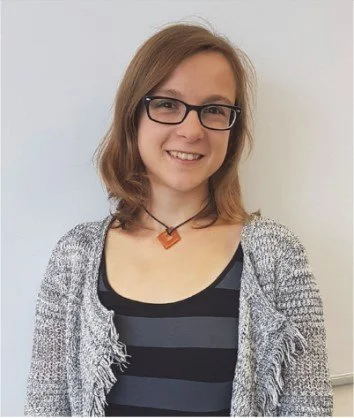
Annika Stellhorn advices younger researchers to stay motivated and connected: the basis for a researcher’s future!
What are you currently working on?
I am instrument scientist for polarization analyzed SANS. Mostly I am working with the SKADI team, which is the SANS beamline at ESS which will be equipped with full polarization capabilities. Sometimes I also join activities from e.g. DREAM or ESTIA.
On the instrumentational side, I am working on the polarization capabilities for SKADI (mostly the Flipper, Analyzer, and magnetic field environments for samples).
On the research side, I am performing hard-matter polarized SANS and GISANS experiments. Regarding data analysis, I am working with the DMSC to define workflows for polarized SANS data reduction and analysis.
What first sparked your interest in your field of research?
It was when I started looking for possible PhD-projects near the end of my master thesis. I took part in a neutron labcourse with both theoretical and experimental parts, and especially the week of performing and analyzing neutron experiments was a lot of fun! Afterwards, I asked for the possibility of a PhD in this field.
What challenge/societal problem are you trying to solve, and why is it important?
My work is on hard-matter systems mostly towards the fundamental physics aspect, e.g. with magnetic / correlated electron systems. It can be applied in different sectors such as data storage based on magnetic materials, energy storage, or quantum technologies, but also e.g. for background substraction or filtering out incoherent scattering contributions.
What has been the most exciting or rewarding part of your work so far?
Regarding instrumentational work: the improvement of the efficiency of SKADI’s Spin Flipper, as this is a very important improvement to the beamline, which will affect any user working with polarization analysis.
Regarding my scientific work: the paper coming out of my collaboration with a theoretical team working on DFT and micromagnetic modelling, as it combines nicely the measured observables (in this case a magnetic chirality) with theoretical calculations on the origin of such.
Why did you become involved in LINXS?
I am part of the YRI for Hard Matter, which is very motivating as it keeps the younger community connected which could help in learning about general neutron/X-ray scattering techniques and analysis programs. I would have liked to join activities like that during my PhD times!
I am also involved in the Quantum Materials theme.
What advice would you give to early-career researchers?
Stay motivated and keep connected – the basis for a researcher’s future!
Read more about Annika Stellhorn at ESS