
Portrait of Professor Peter Schurtenberger – founding Director of LINXS
Professor Peter Schurtenberger founded LINXS in 2017. But the idea to create an institute where researchers from different disciplines could meet to develop science with X-rays and neutrons was formed several years earlier, in 2011.
He was inspired by the Kavli institute for Theoretical Physics in California, where researchers are invited for prolonged research visits. He was also aware of how MAX IV, and later ESS, would need an institute like LINXS to widen the existing user group and drive discussion on technique development, data analysis and experimentation forward.

“To see how LINXS has developed from the slow start when I was participating, to what it is today is great. The new premises are exactly what was needed to make LINXS what it is supposed to be: a place where people love to come and discuss science,” says Peter Schurtenberger, professor emeritus at the Division of Physical Chemistry at Lund University.
As Peter Schurtenberger reflects on his professional career, founding LINXS is one of the things he is proud of. Yet, when asking him to identify other key achievements, he rather emphasises the collaborations that made these breakthroughs possible; and how the results were obtained in non-competitive environments that created the right conditions for free and curious science.
Curiosity led to major breakthrough on equilibrium clusters
As an example, he highlights his and his colleagues’ seminal work on equilibrium clusters in the early 2000s. Through small angle scattering and confocal microscopy experiments on proteins and colloid-polymer systems in solutions, they identified how a combination of short-range attraction and long-range repulsion results in the formation of small equilibrium clusters. These clusters act as temporary units that restrict the mobility of individual particles and explain why proteins, such as antibodies, in solution can sometimes become highly viscous at higher concentrations. This viscosity makes the antibody formulation hard to inject, presenting a difficult to solve challenge for the pharmaceutical industry, as many monoclonal antibody treatments for cancer and other diseases rely on high dosage to be effective. Their paper in Nature, published in 2004, which presented this work has now been cited more than a 1000 times.
“These results were highly influential not just for my own career but also for a whole community in redefining research with significant implications for pharmaceutical research.”
“We now understand why these clusters form, and this knowledge gives the pharmaceutical industry tools to reduce the viscosity.”
The breakthrough was the result of both chance and opportunities to pursue curiosity, Peter Schurtenberger explains. He and his research group had the possibility to perform experiments with one, at the time, brand new small-angle X-ray scattering instrument, without any external pressures to produce results. That allowed them to do many iterations of experiments and testing, trying to understand an unexpected observation without knowing whether this would lead to anything worth publishing.
“For me, this work shows the importance of being able to pursue unhindered research over a long time to arrive at results that require deep theoretical thinking.”
Advancing knowledge on the dynamics of dense suspensions of complex particles and proteins
Other examples of his outstanding work include his research on the dynamics of dense suspensions of complex particles and proteins throughout the 2010s. This work followed the identification of equilibrium clusters and led to additional numerous high-impact publications. Understanding why and how different properties of dense suspensions of complex particles and proteins form is important. It can help control material properties – for example, managing viscosity in cement, paint, or drug treatments – and improve product formulation so that paints, inks and lotions do not set prematurely.
“Within my work I have always been open to move into different directions and take what I learnt in one area and apply it to another. This has served me well and is advice I would give to researchers active today.”
“Through talking to people from different scientific fields or in industry, I have come across many problems that we later managed to solve through collaborations. These meetings only come about if you have a genuine broad interest in solving scientific problems.”
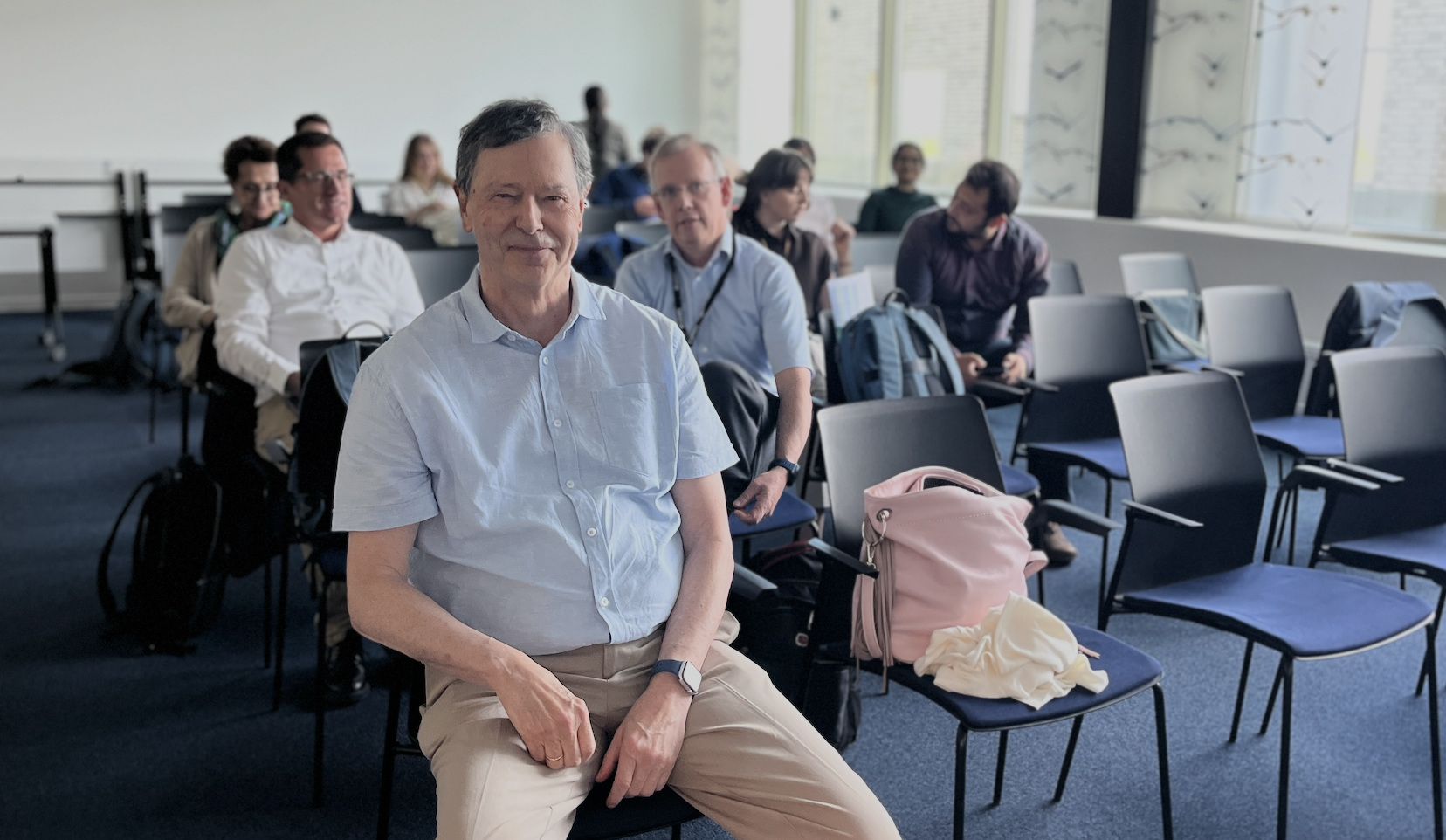
Peter Schurtenberger pictured in June 2025 – at the 45 Years of Soft Matter and Scattering symposium at LINXS.
Collaborators have become friends
Another reflection as he looks back on his career is that, in the end, what was most rewarding was not the scientific results, it was the networks and collaborations he formed.
“I have never been the type to impose close relationships on collaborators, but you realise that by doing collaborations and supervising PhD students and postdocs, you end up creating a family of friends.”
Seeing the many colleagues celebrate the official end to his career at the 45 Years of Soft Matter and Scattering symposium at LINXS in June 2025 brought this home. Following his younger colleagues’ career journeys is something he is now looking forward to.
“I forged my career in a different scientific climate, where I had a lot of freedom to pursue my research interests. My hope is that my younger colleagues will get the chance to do the same. Yet the reality today is harsher, and funding scarcity and bureaucracy create pressures to do more safe science where you can predict results.”
Peter Schurtenberger’s mentoring has made lasting impact on the many PhD students and postdocs he has supervised.
Feifei Peng: “I continue to carry Peter’s teachings with me”
Feifei Peng was one of Peter’s PhD students, defending his thesis on microfluidics and soft matter in 2019. Today he works as an imaging engineer at the medical endoscope company Ambu A/S in Denmark.
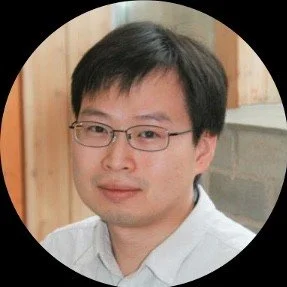
FeiFei Peng works as an imaging engineer at the medical endoscope company Ambu A/S.
“His mentorship left a lasting impact on me. Peter carried a natural authority grounded in calm confidence, and he approached science with exceptional rigor, precision, and insight. Even though microfluidics was also a relatively new area for him, he often offered perspectives that opened new directions in my research. Peter taught me that technical skills alone are not enough – that thoughtful project management and disciplined scientific practice are equally essential,” says Feifei Peng.
“Although my current work is quite different from my earlier academic research, I continue to carry Peter’s teachings with me. His emphasis on rigor, careful attention to detail, and intellectual curiosity still shapes the way I approach my work today.”
Marc Obiols: “That I have a position that I enjoy a lot is in big part thanks to Peter”
Marc Obiols, Industrial Relations Officer at MAX IV, first started working with Peter Schurtenberger in 2008, in Switzerland. Between 2010 and 2013 he was a postdoc in his group before becoming a researcher at the Division of Physical Chemistry at Lund University. In 2016, he left academia for industry. Throughout, they have remained in contact.
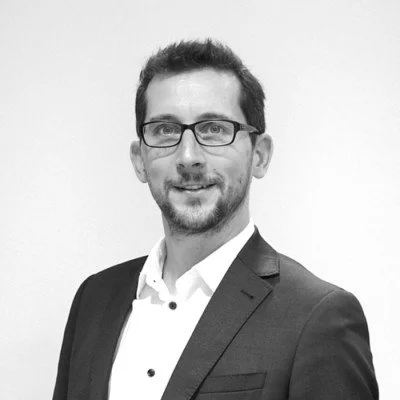
Marc Obiols works as Industrial Relations Officer at MAX IV,
He highlights how he approached Peter when he was thinking about what to do in the future, who asked him: “What would be your dream scenario? Think of it without considering whether it is possible or not. Then I will try my best to make it possible”.
“This was about 10 years ago, but this conversation was a game changer for me,” says Marc Obiols.
“The fact that I have a position that I enjoy a lot is in big part thanks to Peter. He allowed me to develop professionally within the scattering world, being able to perform experiments in X-ray and neutron sources throughout my post-doc and research time in his group.”
“Today I work to empower industry to make use of an advanced large-scale facility such as MAX IV, and thus, I deal with “X-rays” daily with a business mindset. The scientific background gained throughout my seven years under Peter’s mentoring has been key to what I do for a living today.”
Antara Pal: “Peter has allowed me to strengthen my independence and resilience as a researcher”
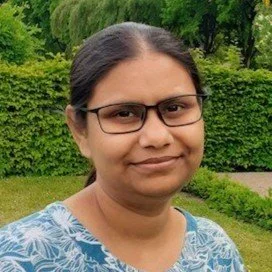
Antara Pal is now working at Malmö University, as a lecturer in the Department of Biomedical Science.
Antara Pal was a postdoctoral researcher under Peter Schurtenberger from 2015 to 2021. She is now working at Malmö University, as a lecturer in the Department of Biomedical Science.
“During my postdoctoral period, we worked together on several research projects that resulted in multiple high-impact publications and helped shape my long-term research trajectory. Peter has allowed me to strengthen my independence and resilience as a researcher. These experiences contributed to the development of my scientific profile and ultimately supported my transition to a permanent academic position.”
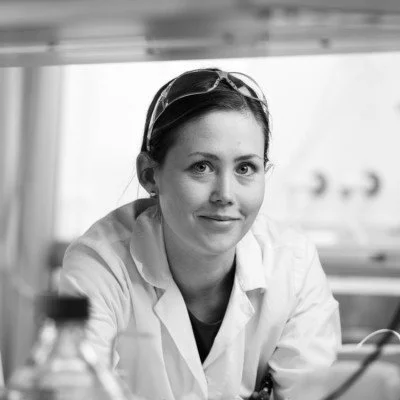
Linda Månsson works at Camurus as a Medical Information Manager.
Linda Månsson: “In Peter, we always had a supporting and encouraging mentor”
Linda Månsson was a PhD student in Peter Schurtenberger’ group. In 2019, she defended her thesis which focused on synthesising colloidal molecules from soft responsive microgel particles. Today she works at Camurus as a Medical Information Manager.
“I want to highlight the importance Peter played in the life of his students. In you we always had a supporting and encouraging mentor, one that always cared for our interests and supported our learning and development. Over the years you have filled our “backpack” with so many useful skills. Moreover, your passion and curiosity for soft matter and for science in general was (and still is) contagious and tremendously inspiring to me!”