
SHINE kick-off sets the course for how to increase knowledge on clinical sample analysis
LINXS’ SHINE theme aims to increase knowledge on how to analyse clinical samples at high resolution. Until now, very few have been studied at large-scale facilities. With advances in imaging and scattering techniques such as electron microscopy and small angle X-ray scattering (SAXS), new possibilities are opening up.
In February, the theme had a kick-off to design and plan its work.

Solving the new challenges that the theme presents excites Karin Lindkvist.
“The event was such an inspirational source! We needed to meet to discuss what these techniques are capable of and what they can give us in terms of scientific data,” says theme leader Karin Lindkvist, Professor at the Department of Experimental Medical Science, Lund University.
Overview of what is currently possible
To highlight where the field currently lies for the analysis of clinical samples, four keynote speakers had been invited to give presentations on methods for studying samples connected to airway disease, neurodegenerative disease, metabolic disease and transmittable disease.
Many of the presentations focused on the use of electron microscopy and scattering techniques. These methods have been used to study topics such as actin remodelling in cells, virus replication, and where inhaled substances end up in the lungs. In Sweden, experiments using electron tomography and electron microscopy can be performed in Umeå, at the Umeå Centre for Electron Microscopy (UCEM).
“It was exciting to hear what is already feasible. Now we can build on this research and start thinking about how to explore everything from methodologies and experiment environments to data analysis,” says Karin Lindkvist.
“One concrete goal is to strike up a collaboration with researchers from the Umeå Centre for Electron Microscopy, who also attended the kick-off.”
Protein analysis at high resolution presents many challenges
Karin Lindkvist explains that data analysis in particular is a prioritised area for the theme. In contrast to more traditional research on proteins, where researchers purify the protein they are interested in investigating in a controlled environment, the data retrieved from experiments with clinical samples is very complex. This is because the proteins are embedded within the cell or even tissue, making it much more difficult to study protein behaviour and structure. Apart from proteins, cells typically contain water, lipids, nucleic acids, carbohydrates, and various inorganic ions.
“The analysis of proteins in cells is not trivial! With these techniques you basically see everything, so you need to know what you are looking for. Larger proteins are easier, like ribosomes, but smaller proteins present a big challenge that we hope to explore.”
The new challenges that this field of study presents are also what Karin Lindkvist finds exciting, and part of why she wanted to pursue the theme.
“As a professor in medical structural biology, I see the study of clinical samples at high resolution as the natural next step in developing a better understanding of health and disease. Only studying proteins on their own cannot give us the full picture of how certain diseases develop or how cell changes upon disease.”
More data on proteins in clinical samples can make prediction models better
She is confident that within ten years, it will be possible to study a range of different clinical samples at large-scale facilities such as MAX IV and ESS and in research environments as the one in Umeå. With more data from these experiments, programmes such as AlphaFold, which predict protein structure and behaviour will also become better.
“If we can provide data on how proteins function in their natural environment, we can support the development of more accurate prediction models. In time, it can make a big difference for our knowledge of how for example diabetes, neurodegenerative disease or lung disease.”
Read more about the SHINE theme (Scattering and Imaging for Health Insights and New Evidence)
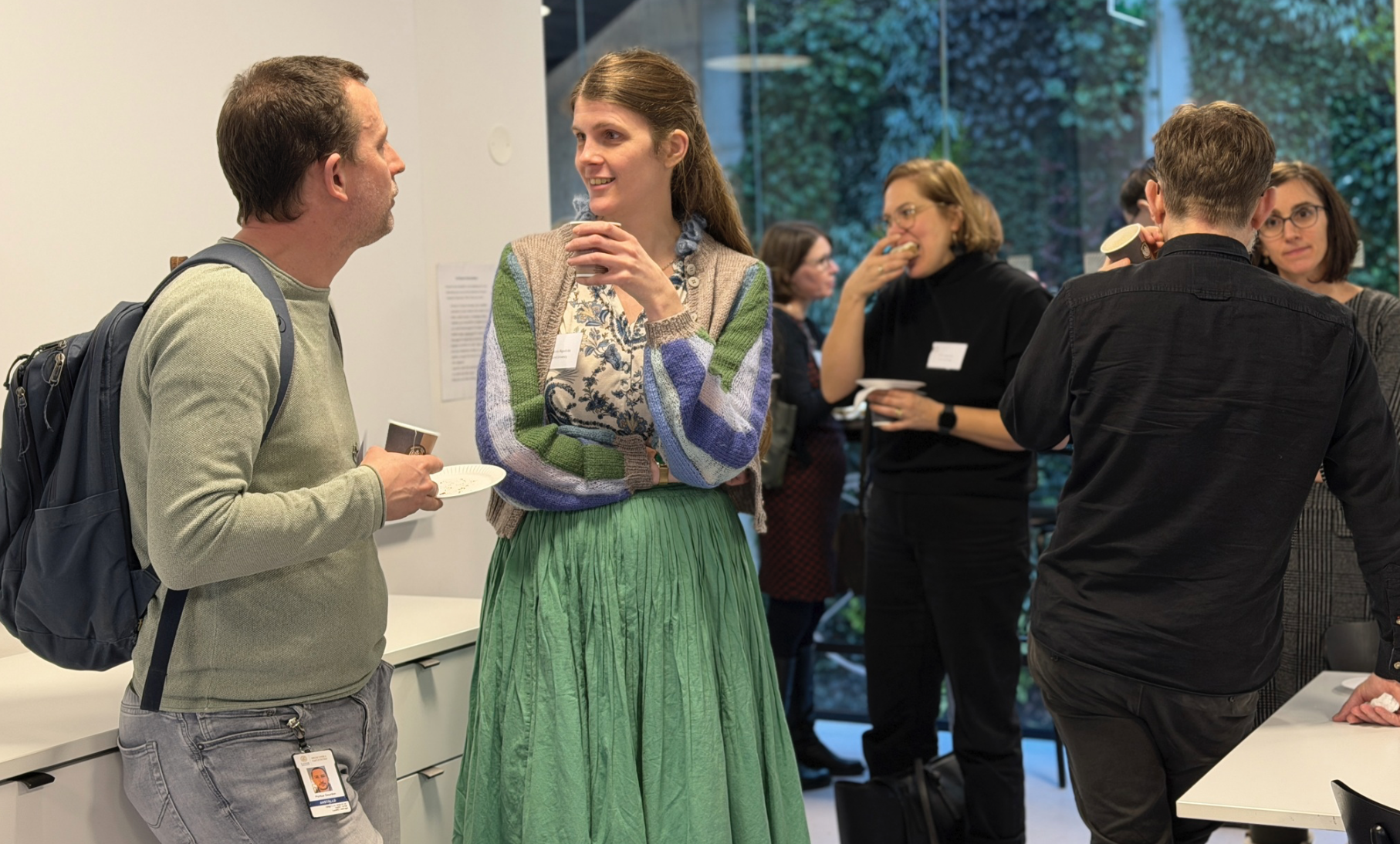
Participants are discussing during a break at the SHINE kick-off at LINXS.