
Meet AMBER postdoc Sebastian Pineda Pineda
Sebastian Pineda Pineda works as an AMBER postdoctoral researcher in the Division of Computational Chemistry at Lund University in Sweden.
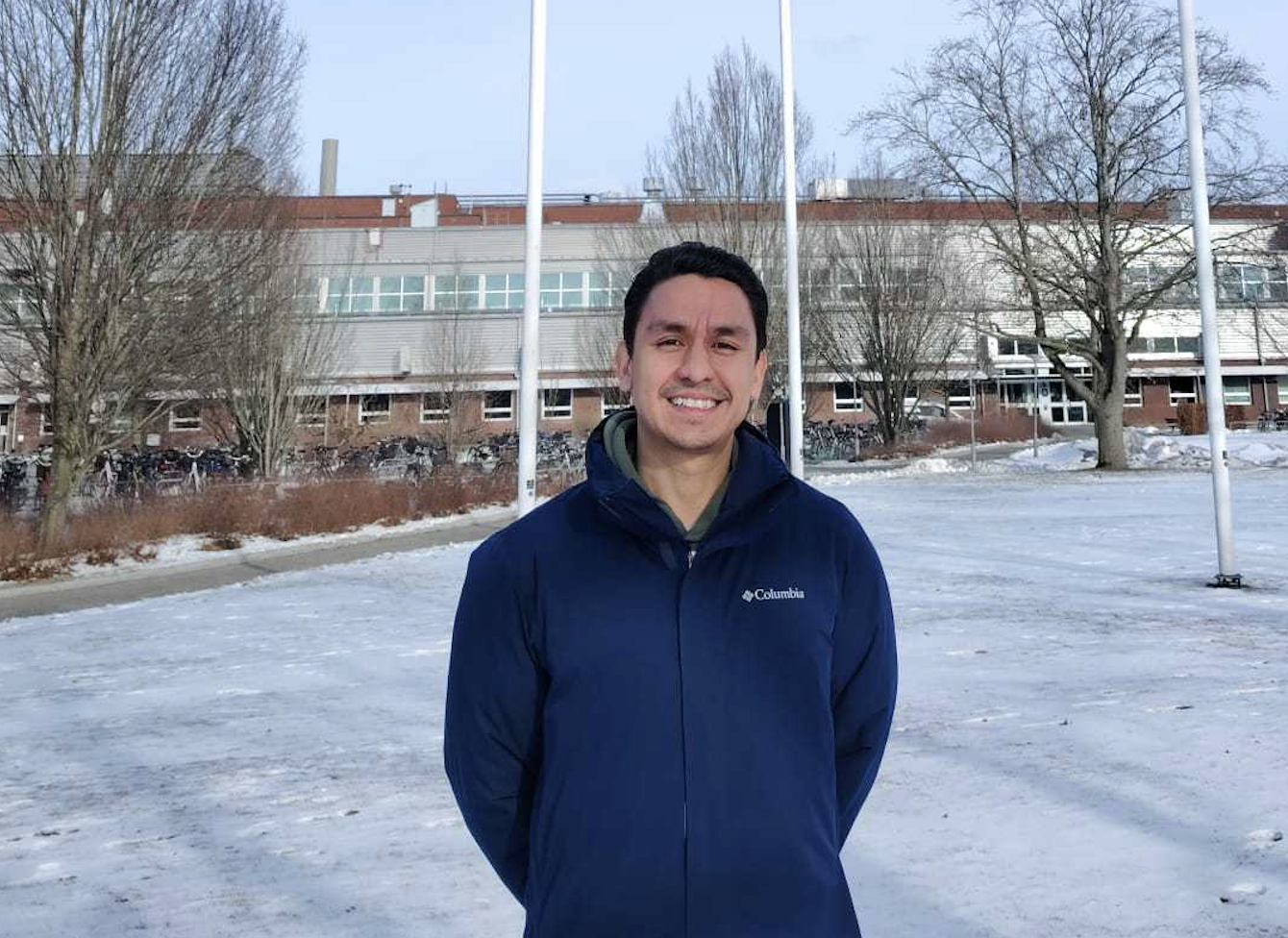
Sebastian Pineda Pineda is interested in studying protein–protein interactions beyond those related to pH changes (charge regulation). Thus, he will focus on interactions that are primarily affected by temperature. Among these, hydrophobic interactions are of great importance, as they are closely related to how water arranges around the protein, influencing both their solubility and structural conformation.
What attracted you to the AMBER position?
When I read the AMBER call and the PI’s aspirations, I immediately felt that it was tailored for me. The topic and PI’s expertise were in complete alignment with my scientific interest, the study of protein–protein interactions. Additionally, the AMBER program offers the perfect interdisciplinary platform and a network connecting many of the most important scattering infrastructures around the globe. What better way to return to experiments than by working with advanced techniques such as SAXS or SANS, while still integrating simulations? Finally, the recruitment process was challenging and fun, and I truly enjoy fun challenges!
What is your background?
Since my early steps in science, I have always been interested in biological, biotechnological, and biomolecular systems. For instance, during my Master’s, I focused on the study of phytohormone production by fermentation, which led to the publication of a patent.
For my PhD, I wanted to continue along the biological line, but I left experiments aside to develop a deeper understanding of physical chemistry from a computational perspective. All the projects during my PhD consisted of simulating coarse-grained systems affected by pH, usually referred to as charge-regulated systems, such as polyelectrolytes or colloidal nanoparticles representing proteins.
Although my main duties were mostly computational, I also focused intensively on the use of potentiometric titrations. Toward the end of my PhD, my experimentalist side blossomed again, and I had the opportunity to explore other techniques such as NMR and fluorescence spectroscopy.
What will you research within your postdoc project?
My current interest is to further expand my knowledge of protein–protein interactions beyond those related to pH changes (charge regulation). Thus, I will focus on interactions that are primarily affected by temperature. Among these, hydrophobic interactions are of great importance, as they are closely related to how water arranges around the protein, influencing both their solubility and structural conformation.
Specifically, I will study them using a combination of mean force calculations, molecular simulations, and experiments. Specifically, I will focus on integrating theories of temperature-dependent hydrophobic interactions, originally developed for intrinsically disordered proteins, into the context of globular proteins.
What is your motivation and drive in your personal and private life?
I have always been driven by curiosity, the pursuit of knowledge, meaningful life experiences and the desire to contribute positively to society. Thus, my main motivations include the opportunity to live in Sweden, learn new, interesting, and challenging techniques, be part of a rich international environment, and contribute to society through my research.
About AMBER
The EU-funded research project AMBER, Advanced Multiscale Biological imaging using European Research infrastructures, addresses scientific and sectoral gaps in biological imaging ranging from molecular, through cellular, to tissue, organ and organism levels of organisation.
AMBER’s partner organisations are: Lund University/MAX IV, Sweden, the European Spallation Source (ESS), Sweden, the European Molecular Biology Laboratory (EMBL), Institut Laue-Langevin (ILL), France, the International Institute of Molecular Mechanisms and Machines, (IMOL), Poland, and the Leicester Institute of Structural and Chemical Biology, United Kingdom.
AMBER is coordinated by LINXS Institute of advanced Neutron and X-ray Science.
Read more about AMBER on: