
Three new research themes to start at LINXS in 2027
LINXS is pleased to announce that three new themes will start in early 2027: Functional Proteins for the Future (FunProF), led by Petri Kursula, University of Bergen, Norway; Accessible Computational Scattering Tools (CATS), led by Mikael Lund, Lund University, Sweden; and Generating Advances with AI for neutrons/X-rays (GAIN), led by Pablo Villanueva Perez, Lund University, Sweden.
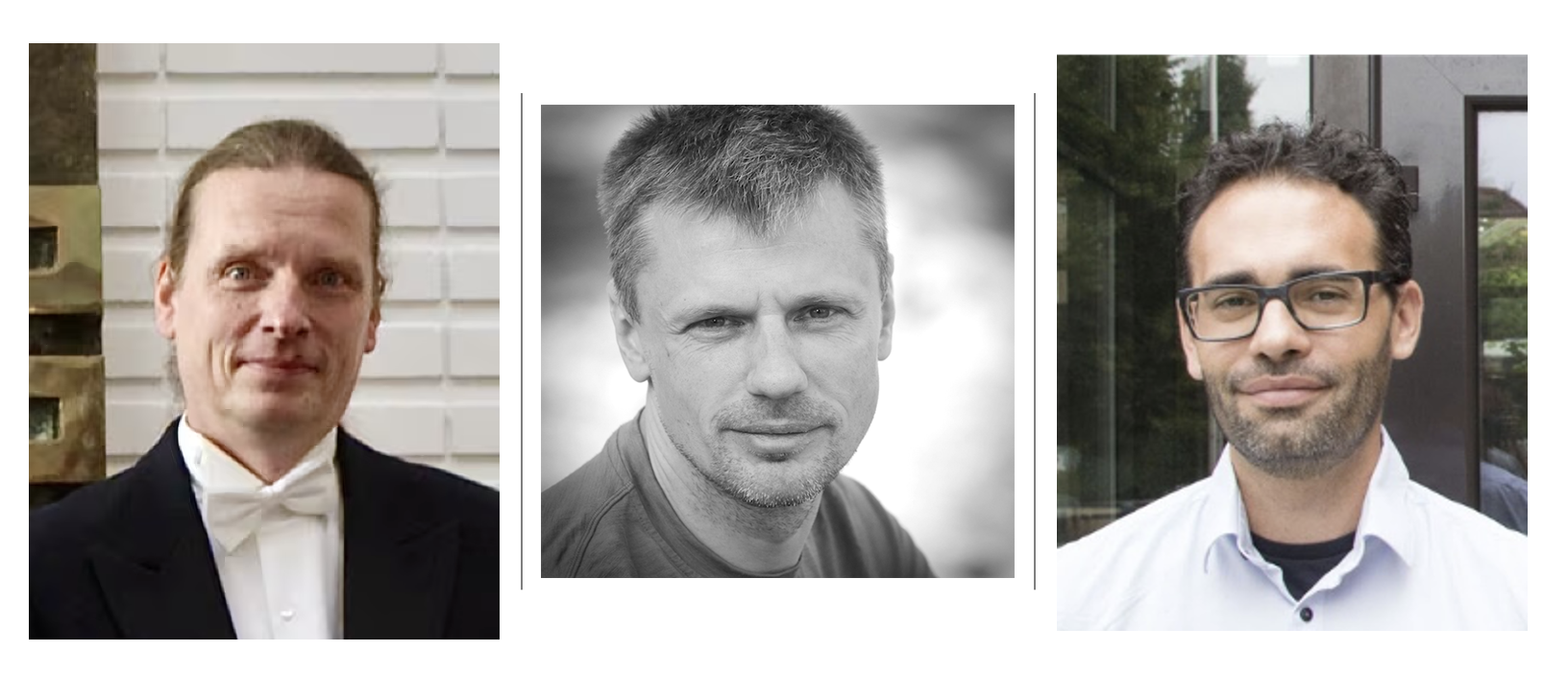
The new theme leaders from left to right: Petri Kursula, University of Bergen, Norway; Mikael Lund, Lund University, Sweden; and Pablo Villanueva Perez, Lund University, Sweden.
“These themes were prioritised by the LINXS Scientific Advisory Board (SAB) and selected from a large number of highly competitive applications. They include initiatives for AI, data interpretation, and protein design/analysis,” says Trevor Forsyth, LINXS Director.
“We extend a warm welcome to the new theme leaders, core groups and working groups. Many of these researchers have been actively involved in LINXS previously, either as visiting researchers or as participants of other activities. That they return to lead their own themes as part of completely new initiatives is very gratifying.”
Themes
Functional Proteins for the Future (FunProF)
Led by Petri Kursula, Professor in Biomedicine, University of Bergen, Norway
The FunProF theme aims to understand, design, and exploit functional proteins. Functional proteins include both different states of proteins in the cellular environment as well as engineered molecular tools that have been established by biotechnology and molecular engineering. The theme will focus on how their structure, dynamics, and performance can be interrogated and optimised using synchrotron and neutron sources.
FunProF will advance the understanding and application of functional proteins through combined experimental and computational approaches, linking experimentalists and data scientists to state-of-the-art facilities. This approach will foster both basic science on protein function and innovation towards sustainable protein-based solutions, expanding the user base and capabilities of large-scale research infrastructures, with a strong Nordic dimension.
The theme will divide its work across four working groups: Working Group 1: Sample production and characterisation workflows; Working Group 2: Experiments on functional proteins at synchrotron and neutron sites; Working Group 3: Computational approaches to experimental design and data analysis; and Working Group 4: Future applications for functional proteins.
Accessible Computational Scattering Tools (CATS)
Led by Mikael Lund, Professor in Computational Chemistry, Lund University
The CATS theme aims to consolidate computational scattering tools and make them available through standardised interfaces and workflows to support users of ESS, MAX IV, other facilities, and industry, to interpret scattering data from concentrated biomolecular and soft matter systems.
By focusing on improving the accessibility and integration of different tools, enhancing interoperability between different systems, and validating tools through experiments, the theme will improve the analysis of scattering data, which up to now has been very challenging, despite small-angle X-ray and neutron scattering (SAXS/SANS) being indispensable techniques for probing structure and interactions in soft matter and biological systems.
The theme will work across five working groups: Working Group 1: Simulation-Based Structure Factors; Working Group 2: Numerical Theory for Structure Factors; Working Group 3: Hydration, Solvation, and Coarse-Grained Scattering Models; Working Group 4: Intrinsically Disordered Proteins and Flexible Systems; and Working Group 5: End-User Integration and Training.
Generating Advances with AI for neutrons/X-rays (GAIN)
Led by Pablo Villanueva Perez, Associate Professor in Physics, Lund University
The GAIN theme aims to establish a collaborative platform and roadmap for integrating AI into MAX IV and ESS, with the goal of making facility operations more efficient, experiments easier to perform and optimise, and the path from experimental data to scientific knowledge faster.
GAIN will bring together three communities: scientists working at large-scale facilities, users of neutron and X-ray techniques, and experts in AI and scientific computing. Together, they will identify key bottlenecks before, during, and after experiments and explore where AI can provide meaningful solutions.
The theme will work across three interconnected working groups spanning the full scientific workflow: Working Group 1: AI for sustainable accelerators; Working Group 2: Beamline controls, autonomous experimentation, and online data analysis; and Working Group 3: AI for knowledge.
By connecting expertise across facilities, users, and AI, GAIN aims to lower barriers to using MAX IV and ESS, accelerate the adoption of AI where it can make a genuine difference, and build a strong community at the intersection of AI, neutron, and X-ray science.